Developing the next generation of separation equipment
StatoilHydro will, together with Chevron and Petrobras, develop a new compact deep-water separation plant.
Published 2008-04-08, 10:25 CET
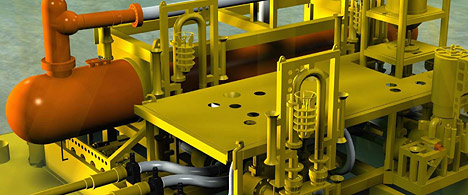
 Known technology elements will be assembled in an entirely new way. The new separation equipment will be far lighter and smaller than the existing solutions.
”The development of compact seabed separation plants is key to success in deep waters, such as in the Gulf of Mexico and off Brazil,” says the activity leader of the CompactSep JIP project, Olav Kristiansen, at StatoilHydro’s research and development centre in Trondheim.
Bilde
 The first laboratory tests will be performed in the low-pressure rig at the research and development centre in Trondheim. Olav Kristiansen, activity leader for the project assigned to develop new separation equipment for deep waters. (Photo: Jorun Hegna)
Seabed processing allows tasks such as separation, pumping and compression to be performed on the seabed rather than on the platforms.
The project aims to develop a plant that will work in water depths down to 2500–3000 metres. Traditional separators are too heavy to be lifted down into such deep waters. They will also get a bulky wall thickness due to great external pressure. Reducing the weight and dimensions is crucial.
”We will build a three-metre high, six-metre long demonstration rig for extensive laboratory and function tests, using model fluids and real fluids, both under low and high pressure,” Kristiansen says.
The first tests will take place in StatoilHydro’s research and development laboratory in Trondheim. The entire separation system will then be tested in a high-pressure rig at the SINTEF research foundation, where larger high-pressure facilities exist.
Finally, StatoilHydro’s research and development centre in Porsgrunn will take over. Full-scale testing of the plant, using real gas and oil types, will be performed here. Parts of the system will at the same time be tested with well stream on the Gullfaks C platform in the North Sea.
The research project is managed and performed by StatoilHydro as a joint industry project (JIP), with the three companies as equal partners. The contract is based on the existing technology cooperation agreement recently signed with Petrobras and Chevron. The project, with a cost limit of NOK 54 million, will run until 2011.
Facts:
* The purpose of the research project is to develop lighter and smaller equipment.
* The Tordis separation plant has a state of the art technology solution for seabed separation. Located in 200 metres of water, the total plant weighs 1300 tonnes.
* With existing crane rigs a Tordis solution can max be lowered down to 1000-metre depth.
* Lighter and more compact separation equipment may be advantageously used on the topside, where the traditional separation tanks are heavy, big and expensive.
Source: StatoilHydro
|