DNV to class Polarcus orders
Athens Dubai-based Polarcus has ordered 6 advanced seismic vessels. All will be built at Dydocks World-Dubai and classed by DNV.

2008-06-05
Right technology, right competence, and right timing are just some of the key elements initiating a series of seismic vessel orders for Dubai-based owner Polarcus. The newly formed company has developed an advanced seismic vessel based on revolutionary ship design to be classed by DNV.
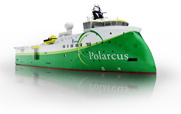 “Seismic vessel operations are in demand as oil companies step up their search for oil and gas reserves. Faced with stiff market competition, Polarcus is in the process of building a young and efficient fleet, which will access wider geographical markets due to the vessels environmental advantages,” says Christer Borjesson DNV’s business development manager in region Middle East.
“We are launching an ultra-modern fleet of initially 6 advanced seismic vessels,” says Peter Zickerman, executive vice president of Polarcus. ”The vessels will provide high-end towed marine 3D and 4D services. The first 12 streamer 3D vessel will be operational in Q3 2009, with all six vessels fully operational within 2010.”
Established last month, Polarcus is a pure play marine geophysical company with a pioneering environmental agenda, specialising in high-end towed streamer data acquisition from pole to pole. All six vessels will feature the ULSTEIN X-BOW®design, along with other important features such as the additional SF class notation for controlled stability and floatability, diesel electric propulsion, dynamic positioning and both Comfort and Clean class notations by DNV.
“Taken together, this will provide for a safer, quieter and more professional work environment onboard, with the lowest environmental footprint of any seismic company operating today,” says Mr Borjesson.
The new Polarcus vessels, dubbed SX, have been designed for the most challenging offshore projects and operating conditions, with close attention paid to system redundancy and clean air emissions to enable Polarcus to operate safely and efficiently in regions ranging from environmentally sensitive frontier zones to established production fields.
The revolutionary design offers several advantages over conventional designs that will make operations more efficient. These include higher transit speed in head seas, giving reduced power consumption or greater fuel efficiency. Reduced noise and vibration levels is another advantage, as is no bow flare, eliminating bow impact and slamming.
DNV
|