
APM Terminals pledges Safety campaign to protect Truckers from accidents in terminals
The Hague, Netherlands - April 29 2015
• Campaign to eliminate accidents aims to keep drivers in their vehicles by end 2016.
• Annual “Global Safety Day” held April 28.
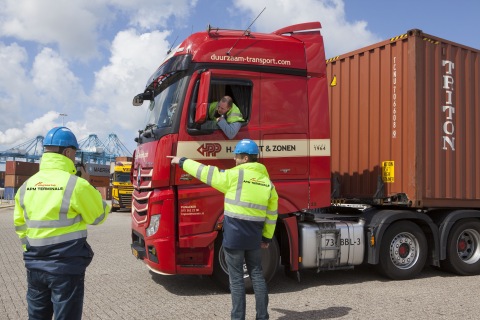
Image by APM Terminals |
“Potential injuries related to outside drivers, trucks, yard traffic, miscommunication and human error can be eliminated by keeping drivers inside their trucks at all times when in our terminals, and that’s the procedure we intend to have in effect at all our facilities by the end of 2016,” said Jeff De Best, APM Terminals Chief Operating Officer. “Terminal operations is a repeat business and our aim is to effectively identify, plan for and mitigate risks to truckers in our facilities. This is a bold move designed to keep our trucker clientele safe and build on our operational excellence vision. We want to be the preferred port operator to truckers worldwide – who know us for safe operations and fast turnarounds. This is the best way we can help their bottom line and keep global trade moving more efficiently.”
|
|
This project is part of a new company-wide program- that aims to eliminate - within the portfolio directly managed by APM Terminals - the five identified primary risk areas associated with 90% of fatal injuries during terminal operations: Transportation (e.g. the movement of containers or cargo within the terminal yard); Suspended Loads and Lifting; Stored Energy (electricity); Working at Heights; Control of (external) Contractors who enter the terminal. Non-terminal employees, including outside truck drivers, are often at the greatest risk of injury during port operations.
“We have successfully put into place safety standards in the form of Global Minimum Requirements (GMRs) across our portfolio as part of APM Terminals’ Safety Culture. This new company-wide program builds upon this work. We believe this is the next step towards preventing any work-place fatality” said APM Terminals Vice President, Health, Safety, Security, Environment and Sustainability, Kevin Furniss, adding “A successful implementation of the standards will require everyone to take on the role of change managers to effectively work together toward one common safety goal.”
Increasing use of automation and evolving terminal operations procedures have already positively impacted the number of outside truckers in some facilities. In APM Terminals Tangier, Morocco truckers cannot enter the terminal yard, while in APM Terminals’ newest port designed for safety, Maasvlakte II in Rotterdam, containers are transported within the yard by a fleet of battery-powered Lift-Automated Guided Vehicles, removing man/machine contact in the container storage yard.
The APM Terminals Global Terminal Network handled 38.3 million TEUs in 2014, weighted by equity share at the 65 operating port and terminal facilities.
APM Terminals press release