|
“Supporting the currently installed offshore generating capacity is today an attractive market opportunity, but the projected growth in new wind farms and wave generator capacity over coming years makes this market sector a strategic component of the Austal Group’s commercial vessel business,” said Mr Bellamy. Mr Bellamy added that Austal brings a wealth of intellectual property to the needs of this new market and has already demonstrated this to Turbine Transfers by designing highly efficient vessels that will achieve greater speeds with a level of fuel efficiency that is superior to that of similar sized vessels in the Turbine Transfers fleet. Austal has adopted an advanced fine entry chine hull form that in association with a high tunnel height, will enable the vessels to operate at speeds of up to 30 knots with targeted seakeeping ability in up to 2 metres significant wave height. Due for delivery in May 2012, the vessels will be built at Austal’s Henderson shipyard. Vessel Specifications Principal Particulars Length overall: 21.30 metres Length waterline: 18.40 metres Beam (moulded): 7.30 metres Hull depth (moulded): 3.50 metres Hull draft (approx): 1.40 metres Crew: 3 Wind Farm Personnel: 12 Maximum Deadweight: 12.5 tonnes Propulsion Main engines: 2 x MTU 10V 2000 M72 Propulsion: 2 x Waterjets Rolls Royce 45 A3 Performance Speed: 30 knots at 100% MCR Survey Classification Det Norske Veritas +1A1 HSLC Windfarm Service 1 R2 E0 Flag UK MCA For further information on this delivery, please click here. AUSTAL AND THE OFFSHORE WIND FARM INDUSTRY Austal Wind Express Series Austal introduced its Wind Express series in mid 2010, in order to capitalise on increasing market demand for transportation solutions in the burgeoning offshore wind farm industry. By utilising Austal’s world-renowned advanced hull design and engineering capabilities, each Wind Express vessel is specifically designed to provide offshore wind farm operators with a rugged, reliable and efficient multi-purpose work boat platform. Characterised by their optimum personnel comfort and safety, each vessel in the Wind Express series can be further customised to suit specific sea conditions, routes, and payload requirements. Further information on Austal’s Wind Express series is available here. The Offshore Wind Farm Industry The Offshore Wind Farm industry is in its infancy, however tremendous growth is forecast by the European Wind Energy Association (EWEA) between now and 2020. The EWEA forecast is aided by the fact that the European Commission has set a binding target of 20 per cent of energy supplies to come from renewable energy by 2020. The EWEA target is for 230GW of installed wind capacity in Europe, 190GW onshore and 40GW offshore by 2020. Annual investments in offshore wind power are expected to increase from €3.3 billion in 2011 to €8.81 billion in 2020. By 2020, the United Kingdom and Germany are predicted to be the largest markets for offshore wind globally. Currently there is a significant pipeline of offshore projects at varying stages of development. There are 17 wind farms under construction in European waters, with an output totalling more than 3,500MW. In addition, a further 52 offshore wind farms in European waters have been fully consented, totaling more than 16,000MW. While the current support and maintenance market is focused on servicing wind farms close to shore, as technology develops and experience is gained, the offshore wind industry will move into deeper water. Future wind farms located further offshore in deeper water will require larger, more advanced vessels capable of operation and safe transfer in up to 2 metre significant wave heights, whereas the current near-shore wind farms are satisfactorily serviced by smaller, simple catamarans ranging from 15-19 metres in length, with the capability to operate in 1.0-1.5 metres significant wave heights. Offshore support vessels are required during both the installation and commissioning phase, and the operations and maintenance phase of offshore wind farms. Current industry practice is that one support vessel is required for every 20 to 25 wind turbines. To achieve EWEA’s target of 40GW of installed capacity by 2020, approximately 7,400 5MW turbines will need to be constructed over the next ten years – a rate of approximately 61 turbines per month. This rate of growth in installed capacity suggests that the forecast demand for offshore support vessels in Europe over the next 10 years is approximately 30 new offshore support vessels per year. Source: The European Wind Energy Association Austal press release |
 Austal Awarded First Wind Express Contract
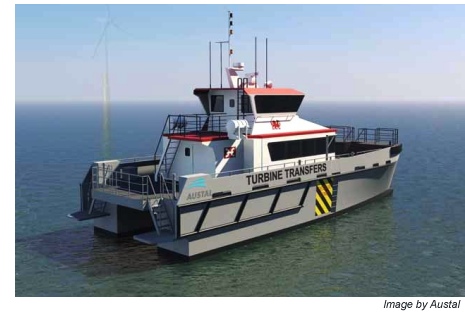 Managing Director of Turbine Transfers, Captain Mark Meade, commented that Austal was selected based on the Western Australian company’s extensive experience in the design and construction of innovative aluminium vessels.