|
As new-design banknotes are introduced so the notes they replace are withdrawn. The Boulton and Watt £50 banknote will initially circulate in tandem with the current £50 banknote featuring Sir John Houblon, the first Governor of the Bank of England, which was introduced in 1994. The final date on which the Houblon £50 note will have legal tender status will be announced in due course. Genuine Bank of England banknotes that have been withdrawn from circulation retain their face value for all time and can be exchanged with the Bank of England. Boulton and Watt – a brief background Matthew Boulton and James Watt were responsible for accelerating the progress of manufacturing steam engines during the 18th and 19th century. Their inventions and improvements to this technology helped make a huge contribution to the progress of the Industrial Revolution. Matthew Boulton (1728-1809) Industrialist and Entrepreneur • Matthew Boulton was a leading and innovating entrepreneur of the Industrial Revolution. • His commercial success contributed greatly to the emergence of Birmingham as a thriving industrial centre with an international reputation. • On leaving school Boulton worked in his father's factory which he inherited in 1759. The factory, located in Birmingham, made buckles for shoes and knee-breeches. • In 1760, he was regarded as one of the most eminent and astute Birmingham manufacturers and built a new factory called the 'Soho Manufactory' on Handsworth Heath. It became the focus of his activities and a showpiece. • Alongside this interest, he was particularly enthused by the development, production and sale of steam engines and the minting of coins. • In 1775 Boulton went into partnership with James Watt (1736-1819) whose improvements to steam engine design had led to greater efficiency and cheaper running costs. • Boulton and Watt pioneered the use of the steam engine in the cotton spinning industry. By 1800 the market for this type of engine had become worldwide and was selling more of this type of engine than the earlier design. • In order to augment the supply of coin provided by the Royal Mint, Boulton established the Soho Mint, and it was there, using steam-driven machinery, that coinage of the highest quality was produced. James Watt (1736-1819) Engineer and Scientist • James Watt was the great improver, not the inventor, of the steam engine. While repairing a Newcomen steam engine he was struck by the considerable steam wastage inherent in its design and realised that it could be made more efficiently. • Progress in this development was slow until he entered into partnership with Matthew Boulton in 1775, with Boulton providing many suggestions for improving Watt's engines. • Encouraged by Boulton, Watt developed an engine for the textile industry in 1774, patenting the invention in 1781. • Watt introduced the term 'horsepower' and the metric unit of power is named after him. • Watt was involved in several civil engineering projects during his life, the most significant of which was a survey and estimate in 1773 for a canal between Fort William and Inverness. The canal was constructed in the early 19th century and named the Caledonian Canal. Bank of England news release |
 New-style £50 banknote issued today
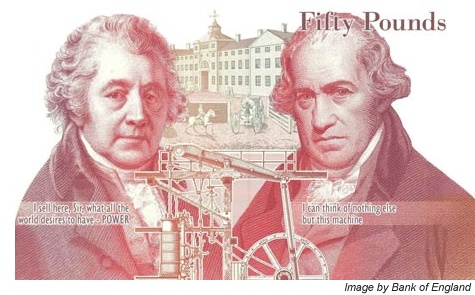 The Boulton and Watt £50 banknote marks the first time two portraits have appeared together on the back of a Bank of England banknote. It will also be the first banknote in circulation to be signed by Chris Salmon, who was appointed as the Bank’s Executive Director for Banking Services and Chief Cashier in April 2011. Commenting on the features of the new note, he said: “The Boulton and Watt £50 banknote has new and enhanced security features which demonstrate the Bank’s commitment to its role of maintaining public confidence in the currency. The motion thread security feature is one of the new measures which should help members of the public to identify genuine £50 banknotes’.