|
Production from Kinnoull is forecast to peak at 45,000 barrels per day and be exported via the existing Forties pipeline system to Kinneil and the CATS pipeline system to Teesside. BP owns 77.06%, with other interests as follows: Eni (16.67%); JX Nippon (6.27%); • Since it started production in 1996 BP’s Andrew platform has processed and exported over 200 million barrels of oil and the equivalent of a further 40 million barrels in associated gas. • The platform is operated and maintained by up to 80 people and is located 230 kilometres north east of Aberdeen. • The Borgholm Dolphin flotel has been at the Andrew platform since Q1 2011 and has provided additional beds for up to 180 people to support Andrew platform work and tie-in of the module to the Andrew platform. Up to 270 personnel are offshore at any one time during the outage periods. • The new Andrew Lower Cretaceous facilities will allow the Andrew platform to produce from this known reservoir underneath the Andrew platform. • In order to access the Kinnoull reservoir, the project has installed a new subsea system with the following key components. 1. Three subsea trees above the Kinnoull reservoir to control the new production wells. 2. At the Kinnoull end of the pipeline system lies the collection manifold, which houses valves to divert the fluids along the bundle and metering to collect production data. Closest to Andrew, the bundle terminates in the pipeline end manifold (PLEM) which contains the subsea isolation valves. Mid-way along the bundle system lies a tie-in structure to facilitate future development of the Arundel oil field. 3. The backbone of the whole subsea system is a 28 km bundle, which will carry the fluids to the Andrew platform for processing. The Bundle contains 3 internal pipes: a 3 inch methanol line, a 6 inch gas lift line and an insulated 14 inch production line. The 28 km pipeline system was installed as four separate 7km sections. 4. The caisson is a 130 metre long riser that will contain all the pipework to carry the fluids and signals between the platform and the seabed. • Detailed engineering will be performed in Aberdeen by JP Kenny and Wood Group Engineering. Over 2 million man hours will be required to complete the design work. • Fabrication of key items will take place: - In Wick: where Subsea 7 fabricated and launched the 4 bundle sections; - In Leeds: where Cameron machined and assembled the subsea trees; - In Bristol: where Vetco Gray are manufacturing and testing the subsea control system; - In Invergordon: where Isleburn fabricated the riser Caisson and subsea structures; - In Newcastle: where Duco are producing the 28km umbilical and where Bel fabricated the subsea valves; - In Hartlepool: where Heerema built and commissioned the 700 tonne process module; BP press release |

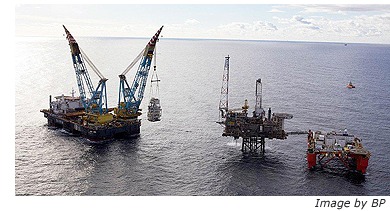 Trevor Garlick, Regional President for BP’s North Sea business said: “The Kinnoull project is significant to the North Sea business, and wider BP, and is a clear example of the company’s strategy in action. Advances in our understanding of the reservoir structure, deployment of the very latest in UK subsea engineering skills and a major upgrade of the Andrew platform are key success factors of this development.”