|
Getting cargo off roads The two Dutch companies originally met each other about four years ago. Bodewes Binnenvaart was at that time starting to develop a low emissions concept for inland waterway shipping and the QaGroup was exploring using LNG as an alternative fuel. As well as that Bodewes Binnenvaart was working on ACES, where the first stunning results at full-scale had just been recorded at Maritime Research Institute Netherlands (MARIN). They discovered that both their systems had the same aim of saving fuel, costs and reducing emissions. They both had a clear view: combine these two solutions into one pioneering design and then an even stronger concept is created. “We expect this new concept to appeal to shippers of consumables particularly, oil companies and logistic operators keen to get their cargo off the roads and keen on having one partner, one contact to deal with.” Sophisticated power management Although the LNG/ACES system can be fitted to any inland ship, at the moment the system has been designed around a 110 m long vessel, the EcoLiner, which is based on the well-known Damen River Liner 1145. The new vessel has a bunker capacity of approximately 45 cu m LNG and it will be fully classified by Bureau Veritas. The vessel is equipped with four generator sets and these power all of the consumers via the comprehensive power management system. The power management system ensures efficient energy generation, distribution and storage. Inland shipping For example, there is more power needed going upriver from Rotterdam to Basle than on the return, so the management system will automatically switch the generator sets on and off. Mr Schuurmans adds: “A typical ship engine runs most efficient at a load of 80% of its full power. With four generator sets the power management system will ensure the engines do so. Energy created can be stored when using less power or instead it can be used to heat or cool the cargo or for cooling water or heating accommodation. In addition, waste heat is used and becomes energy, so absolutely nothing is wasted. On top of this, there’s the 15% fuel reduction because of the ACES hull.” Extensive trials have proven that fuel savings of around 25% can be realised on the EcoLiner. Guaranteed uptime The concept provides reliability and guaranteed maximum uptime. The separate generators means that there is built in redundancy and the LNG vessel also comes with a Damen full service contract, which guarantees maximum uptime and service 365 days a year. Damen engineers can carry out maintenance while the vessel is continuing to do its job. The partners are already exploring markets in Germany, Belgium and the Netherlands but also they are going further afield in Brazil, China and India and say they have received a very positive response worldwide from leading shippers and barge companies. A future industry standard “This gives shippers the chance to operate along “green corridors” and to reduce their total cost of ownership because ultimately they can make huge savings on transport costs. “We want to change the market. This is an innovative, safe, environmentally friendly and extremely cost competitive concept. There is no reason why it cannot be the inland shipping industry standard for the future,” the partners stress. Damen Shipyards Group press release |
 New EcoLiner: inland shipping on LNG
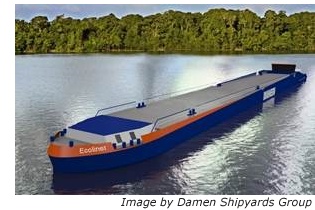 Bodewes Binnenvaart B.V., Damen Shipyards Group’s inland waterway shipyard, and inland shipping company QaGroup are set to launch an entirely new inland shipping concept, which they believe will set a new industry standard in inland shipping. Both companies have combined their knowledge as to designing and operating the vessel.