|
During the monitoring campaign the E3 team found that the average load profile showed that tugs are running inefficiently for most of the time. For up to 80% of the day they can be free sailing, station keeping, running idle essentially, and in turn, this makes them less environmentally friendly and leads to higher operational costs. The diesel electric propulsion system in the ASD Tug 2810 Hybrid delivers enough power to prevent the main engines of the diesel direct propulsion system from running idle frequently or at low loads. During the E3 project Damen’s Research Department made a computer simulation model to analyse various propulsion trains. Damen can use this simulation model to calculate the exact savings that are possible from the Hybrid in each individual case, based on the tug’s operating profile and running hours. Based on the findings and after looking at various battery, LNG, hydrogen and compressed natural gas solutions, the Hybrid emerged. NOx, HC, CO, SOx, CO2 and particles all decrease substantially, as does fuel consumption. Battery option As an option, Damen is also offering a battery pack whereby it is possible to shut down all the engines during station keeping, manoeuvring and free sailing at low speeds, making the vessel even more environmentally friendly. Battery packs of 100 kWh each are likely to be provided, which allow the vessel to sail up to 5 knots. The Iskes Hybrid will be incorporating batteries. Mr Iskes stressed that the company was very keen to have a combination of the diesel electric and batteries. “A 100kWh battery allows the vessel to be alongside the quay for eight hours and sail for an hour. And this represents a 10 to 15% fuel saving. Batteries make it much more comfortable for the crew because when they are asleep, energy is coming from the batteries so there is no noise or emissions.” Solar panels Solar panels are added to the deckhouse on the Damen standard version and these are used to charge the 24V battery packs for starting the engines and emergency power for navigation lighting and radio equipment. Other green initiatives on the vessel include LED lighting, and a special paint coating, making the vessel more environmentally friendly and clean for at least five years. Customisation of the Iskes ASD Tug 2810 Hybrid for Anchor Handling includes double drum winches fore and aft, wooden decks and an open stern with towing pins and chain stopper forks. Technical details Proven technology Damen wanted to use tried and tested technology for the ASD Tug 2810 Hybrid. One additional clutch has been added to the vessel and a 230 kW water-cooled electric propulsion engine between each main engine and the rudder propeller. One fire-fighting/generator set is installed to feed the electric propulsion engines or to drive the 1200 m3/hr fire-fighting pump. The generator/fire-fighting set engine is fitted with an exhaust gas after-treatment system consisting of a Selective Catalytic Reduction (SCR) system, a Diesel Oxidation Catalyst (DOC) and a half open, Diesel Particulate Filter (DPF). The fire-fighting/generator set engine can deliver 695 kW at 1800 rpm and is fully compliant with the IMO Tier 3 regulations being introduced in 2016. Iskes says that actually the operator expects to be utilising the IMO Tier 3 compliant engine 90% of the time. Each main engine has a maximum power of 1840 kW at 1600 rpm and is IMO Tier 2 compliant. Operating modes The captain can choose one of the following operating modes from the wheelhouse and then the Hybrid Control Unit manages everything automatically. - Stand-by mode (only in combination with the optional battery pack) All diesel engines will shut down and the battery pack feeds the normal electric system and the electric propulsion engines that are driving the rudder propellers. When the battery pack becomes empty the system will switch to free sailing mode automatically and the battery pack will be charged. The stand-by mode can be used for station keeping, manoeuvring and free sailing at speeds of up to 5 knots. - Free sailing mode The generator/fire-fighting set starts and feeds the electric propulsion engines that are driving the rudder propellers. The main engines are not running and the auxiliary generator set is feeding the normal electric system. The free sailing mode can be used for station keeping, manoeuvring and free sailing at speeds of up to 8 knots. - Towing mode Main engines start and drive the rudder propellers. The generator/fire- fighting set is not running and the auxiliary generator set is feeding the normal electric system. The towing mode has to be used during push/pull operations and free sailing of up to 13 knots. - Fire-fighting mode The fire-fighting mode has to be used during fire-fighting operations. Main engines start and drive the rudder propellers. Generator/fire- fighting set starts and drives the fire-fighting pump. The auxiliary generator set is feeding the normal electric system. Damen Shipyards Group press release |
 Damen launches its first ever hybrid tug
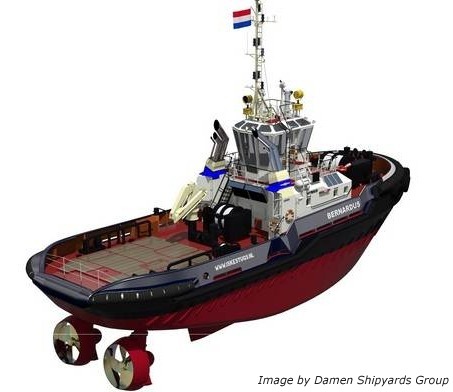
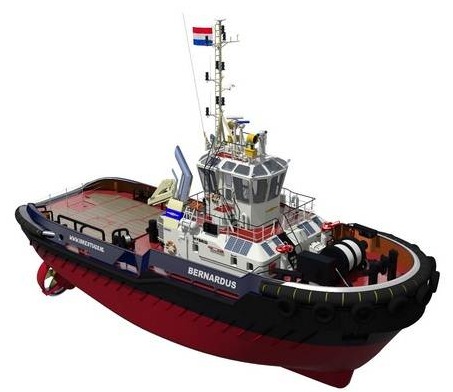 Damen Shipyards has launched its first ever hybrid tug - the ASD Tug 2810 Hybrid - and is proud to announce that Iskes Towage & Salvage will be the launching customer. The signing ceremony took place today (October 23), at Offshore Energy in Amsterdam. The pioneering Dutch shipyard group is believed to be the only yard worldwide building hybrid tugs for stock. The second hybrid vessel will be available from stock end-2013.
 “Damen welcomed our input and recognises that we know what we are talking about. Many of the things we require are not standard but Damen has worked with us to incorporate them.”