 Large LNG-fuelled container ship granted approval in principle
19 Jan 2012
Oslo: Kawasaki Heavy Industries has completed the development of a large, 9 000 TEU container ship fuelled by LNG and obtained Approval in Principle from DNV. The ship is designed with a new type of LNG tank that provides more space for container cargo.
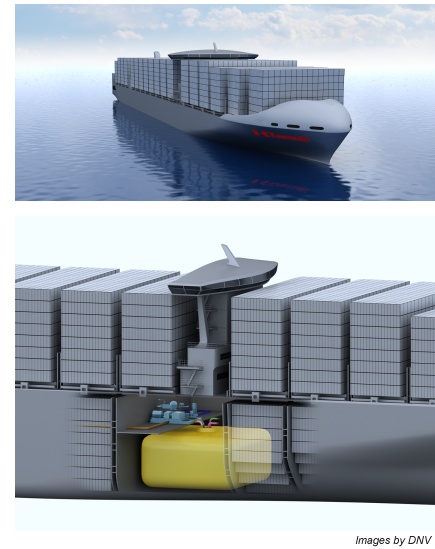 The LNG is stored in prismatic low pressure insulated tanks (Type B) and this is the first time that such tanks have been proposed for a large container ship. They are different from cylindrical pressure tanks (Type C) as they utilize the available space much better due to their prismatic, rectangular shape. KHI has also adopted a unique technology, the Kawasaki Panel System, for heat insulation in order to reduce the rate of evaporation of LNG.
B-type tanks produce evaporating LNG continuously which must be used for propulsion or auxiliaries. Reefer containers will consume the boil off in port eliminating any emission of LNG to air, as well as eliminating the need for cold ironing.
KHI obtained DNV Approval in Principle for both the gas supply system of the vessel and the LNG fuel tanks. Next, KHI plans to perform a safety assessment of the vessel with DNV.
The LNG fuel tank and diesel oil tanks are located under the forward superstructure minimising the loss of cargo space. The design criteria for ships using LNG as fuel are currently being studied by IMO (BLG). The location of LNG tanks under the accommodation has been a subject for discussion in the industry. DNV plays an active role in these discussions.
There are high expectations for LNG as an alternative, next-generation clean fuel to reduce reliance on heavy fuel oil which is currently used for large container ships. LNG was chosen as the fuel for the vessel because it reduces carbon dioxide (CO2) emissions which contribute to global warming as well as dramatically reducing nitrogen oxides (NOx) and sulphur oxides (SOx) which are major health hazards.
DNV is also promoting LNG as it is proving to be an economically favourable emissions reduction solution for shipowners. Decoupled from oil prices due to sources such as shale gas, it is expected to remain competitive for the lifetime of new vessels entering the market. 25 ships in Norway are already floating evidence of LNG’s safety and technical feasibility, and DNV has had rules in place for over 10 years.
The new container ship design features:
(1) A twin island design maximising cargo space available for loading containers.
(2) A two stroke dual-fuel main engine which is electronically controlled with a high combustion efficiency coupled with a hull form optimised for safety and fuel efficiency.
(3) The engine may be equipped with an exhaust gas recirculation system (EGR) which satisfies IMO Tier-3 requirements for voyages in North American and European Emission Control Areas (ECAs).
KHI will apply the technology and design principles used to other container ships as part of the company’s goal to be world leaders in the development and construction of innovative eco-friendly vessels. With KHI technologies acquired through the past development and construction of LNG carriers, KHI also plans to move into the field of LNG bunkering vessels to further extend the scope of their environmental offerings.
DNV has demonstrated the feasibility of a range of large LNG fuelled ships through concept studies such as the container ship Quantum 9000, Triality, a VLCC size oil tanker, and two different sized bulk carriers. “DNV is proud to be working with forward-thinking companies such as KHI to help make clean shipping a reality,” says Tor Svensen.
Principal particulars of the new 9,000 TEU LNG-fuelled container vessel
Length overall 308 m
Breadth 48.4 m
Draught 14.5 m
LNG fuel tank 7,000 m3
DNV press release