 First true hybrid system to be installed on board an offshore supply vessel
2012-03-14
London: A true hybrid energy system is currently being developed for installation on board the offshore supply vessel Viking Lady. An impressive battery pack for energy storage will soon be installed. When the new system is complete, the operation of the engine will be more smooth and cost effective giving further emission reductions.
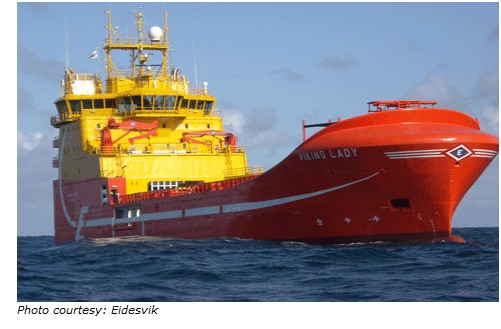 The Viking Lady is not like any other offshore supply ship. The three-year-old LNG-fuelled vessel, which is owned by Eidesvik Offshore, was the very first merchant ship to use a fuel cell as part of its propulsion system. The fuel cell, which generates an electric output of 330 kW, was installed in the autumn of 2009 and has successfully run for more than 18,500 hours. Based on this, the Viking Lady is already one of the world’s most environmentally friendly ships.
Now another first step is to be taken to reduce its emissions even more. Once the battery pack is in place, the ship will operate using a hybrid system similar to that which has been installed in hybrid cars for a number of years. However, the potential emission reductions are higher and the return on investment period is shorter for ships than it is for cars.
The primary potential benefits of the hybrid energy system for a ship like the Viking Lady are a 20/30% reduction in fuel consumption and CO2 emissions through smoother and more efficient operation of the engines and fuel cell. The reductions of other exhaust components are even higher.
The whole shipping industry is currently facing record-high fuel costs. Based on these actual costs, the return on investment period for the hybrid system is estimated to be less than two years.
Bjørn-Johan Vartdal, DNV’s project manager says: “We know that the hybrid system will reduce the energy consumption. When operating, for example, on dynamic positioning, there will be a major fuel saving potential. When in harbour, too, the ship should be able to operate on the fuel cell and its battery power alone, which will reduce emissions significantly. For environmentally sensitive areas, this will be an essential benefit. Additional benefits are related to reductions in machinery maintenance costs and in noise and vibrations.”
A comprehensive measurement program will be carried out to verify the savings potential. The hybrid system will also be modelled in detail. Calibrated and verified process models will facilitate simulation and optimization of future hybrid systems.
The new DNV class rules for battery-powered ships have been developed in parallel to this. These are the first class rules developed in order for batteries to be used as part of a vessel’s propulsion energy - both as hybrid solutions and for “pure” battery-driven vessels.
The project is due for completion in 2013.
About FellowSHIP
FellowSHIP is a joint industry R&D project with the objective of answering a growing call for sustainable energy generation for marine and offshore use. The project was initiated with the goal of developing and demonstrating maritime fuel cell power packs, and has been extended to include tests of a hybrid system for maritime use. The FellowSHIP partners are the shipowner Eidesvik Offshore, ship designer/power electronics developer Wärtsilä and the classification society DNV. The FellowSHIP project is financially supported by the Research Council of Norway.
About DNV
DNV is a global provider of knowledge for managing risk. Today, safe and responsible business conduct is both a licence to operate and a competitive advantage. Our core competence lies in the identification and assessment of risks and provision of advice on risk management. From our leading position in the fields of certification, classification, verification and training, we develop and apply standards and best practices. These help our customers to safely and responsibly improve their business performance. DNV is an independent organisation with dedicated risk professionals in more than 100 countries and its objective is to safeguard life, property and the environment.
About Eidesvik Offshore ASA
Eidesvik Offshore operates worldwide with a modern fleet of highly specialised offshore supply, seismic and subsea vessels. Eidesvik Offshore focuses on quality and safe operations to support its client’s objectives and its operational and financial targets. Eidesvik Offshore is known for its innovative environmental solutions with, among others, LNG and fuel cell technology. Several of the vessels are developed by Eidesvik Offshores own project department in close cooperation with our business associates, clients and naval architects.
About Wärtsilä
Wärtsilä is a global leader in complete lifecycle power solutions for the marine and energy markets. By emphasising technological innovation and total efficiency, Wärtsilä maximises the environmental and economic performance of the vessels and power plants of its customers. In 2011, Wärtsilä’s net sales totalled EUR 4.2 billion with approximately 18,000 employees. The company has operations in nearly 170 locations in 70 countries around the world. Wärtsilä is listed on the NASDAQ OMX Helsinki, Finland.
DNV press release