|
Neil Duffin, president of ExxonMobil Development Company, said, “The project will be developed in compliance with the highest standards for health, safety, environmental and social safeguards and will maximize the value of the resource, supporting the PNG government’s objective to strengthen its economy and infrastructure base for the benefit of its people. The comprehensive national content plan focuses on development of the local workforce, expansion of supplier capability, and strategic community investment.” Funding for the PNG LNG project will come from the co-venturers and through market-rate loans arranged with export credit agencies and commercial sources. “The project team successfully negotiated this complex transaction for the project in a very difficult financial market. We believe our record of developing and operating world-class assets was a key component of this successful financing,” Duffin added. In May 2009, the Independent State of Papua New Guinea, representatives of project area landowners, and four provincial and 10 local-level governments approved the PNG LNG Umbrella Benefits Sharing Agreement, confirming support from landowners and all levels of PNG government. The overarching agreement outlines the sharing of revenue streams from royalties, development taxes and equity dividends totaling between US $5.6-7.5 billion (15-20 billion PNG kina) over the project life. The government of Papua New Guinea, through its Department of Environment and Conservation, approved the project's environmental impact statement that reviewed factors such as community needs, sensitive environmental habitats, and biodiversity. The project will supply four major LNG customers in the Asia region through long-term sales, including: CPC Corporation, Taiwan; Osaka Gas Company Limited; The Tokyo Electric Power Company, Inc.; and Unipec Asia Company Limited, a subsidiary of China Petroleum and Chemical Corporation (Sinopec). The PNG LNG project is a key part of ExxonMobil’s strategy to capture opportunities in the growing natural gas markets around the world. ExxonMobil expects that the demand for natural gas in Asia Pacific will more than double by 2030 and will rely on LNG imports that will satisfy more than one-third of the region’s demand within this timeframe. Natural gas can help meet the growing need for electricity and it has fewer carbon dioxide emissions than other fuel sources. About ExxonMobil ExxonMobil, the largest publicly traded international oil and gas company, uses technology and innovation to help meet the world’s growing energy needs. ExxonMobil holds an industry-leading inventory of resources, is the largest refiner and marketer of petroleum products, and its chemical company is one of the largest in the world. For more information, visit www.exxonmobil.com. ExxonMobil |
 Papua New Guinea LNG Project Clears Final Conditions to Proceed
 “The project team successfully negotiated this complex transaction for the project in a very difficult financial market. We believe our record of developing and operating world-class assets was a key component of this successful financing”
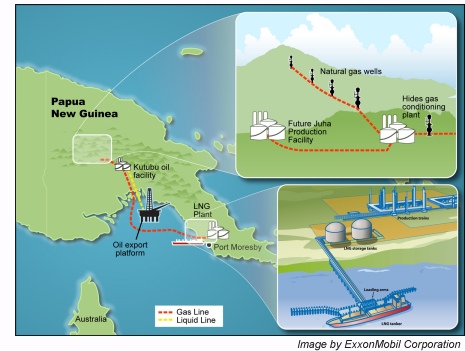
The integrated development includes gas production and processing facilities in the Southern Highlands and Western Provinces of Papua New Guinea; liquefaction and storage facilities with capacity of 6.6 million tons per year, located northwest of Port Moresby on the Gulf of Papua; and over 450 miles (700 kilometers) of pipelines connecting the facilities.
“The project team successfully negotiated this complex transaction for the project in a very difficult financial market. We believe our record of developing and operating world-class assets was a key component of this successful financing”
The integrated development includes gas production and processing facilities in the Southern Highlands and Western Provinces of Papua New Guinea; liquefaction and storage facilities with capacity of 6.6 million tons per year, located northwest of Port Moresby on the Gulf of Papua; and over 450 miles (700 kilometers) of pipelines connecting the facilities.