|
The Dzhubga – Lazarevskoye – Sochi gas pipeline has been entered into the governmentally approved Program of the Russian Federation Government for the construction of Olympic facilities and development of Sochi as a mountain-climatic resort. The gas pipeline will stretch 177 kilometers including a 159.5-kilometer offshore section. The pipeline route will run on the Black Sea bottom along the coastal line (around 4.5 kilometers away from the shore) to the Kudepsta gas distribution station near Sochi. The gas pipeline will have onshore sections near Dzhubga, Novomikhailovskoye, Tuapse and Kudepsta. The 530-millimeter gas pipeline will have the annual throughput capacity of some 3.8 billion cubic meters. The Dzhubga – Lazarevskoye – Sochi gas pipeline will be conducted in a most climatically attractive and, therefore, a most cherished region of the country, the Caucasian coast of the Black Sea. It will run via a number of areas, including resorts, that have a specific mode of natural resources management. Therefore, Gazprom takes great care of environmental activities during the pipeline construction. The construction schedule has been worked out with due regard to the most vital biocycles of the local fauna species and enables to maximally reduce the environmental impact caused by the construction process. All the operations will be held in compliance with the globally accepted standards and rules for engineering and building of submerged pipelines. The gas pipeline design has obtained a positive conclusion from the State Environmental Expertise and an approval from the State Environmental Expertise Department (Glavgosekspertiza). The most thorough calculations prove that the environmental impact imposed by the pipeline construction will only be observed locally and in the short run. The offshore option of the gas pipeline route has minimized allocation of industrial, agricultural and forest lands, as well as specially protected natural reservations. The most suitable coastal line crossing procedure, horizontal directional drilling, considerably mitigates the environmental impact on the most vulnerable coastal ecosystems. As a result, it will be possible to avoid interference into the coastal wildlife area. Provisions are made in the gas pipeline construction project for all the environmental payments and compensations required by the legislation in force. The most advanced equipment, such as excavators and pipe layers, will be used for construction. The Dzhubga – Lazarevskoye – Sochi gas pipeline will be constructed with no disruption of the regional landscape, which is especially important for the animal ecosystem preservation. It is projected to complete the pipeline construction in the second quarter of 2010. Information Directorate, OAO Gazprom |

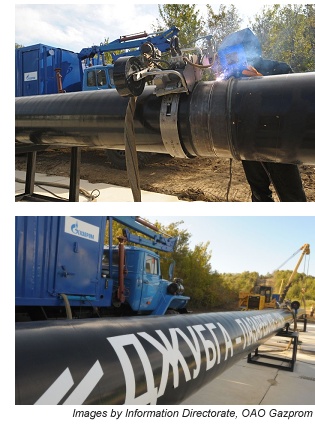 The first joint of the Dzhubga – Lazarevskoye – Sochi gas pipeline has been welded today near the settlement of Dzhubga, Krasnodar Krai.