 First voyage of the CMA CGM Marco Polo
12.12.2012
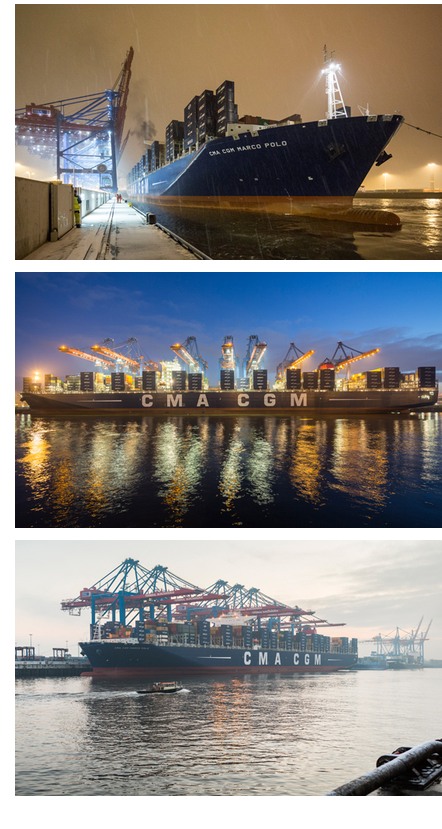 Hamburg was the first continental European port of call on the maiden voyage of the CMA CGM Marco Polo. The mega-ship, with a capacity of 16,020 standard containers, is being handled at the HHLA Container Terminal Burchardkai. The French shipping company CMA CGM sets great store by Hamburg because of its geographic location and hinterland links.
On Wednesday morning, the CMA CGM Marco Polo became the first container mega-ship with a capacity of more than 16,000 standard containers (TEU) to call at the Port of Hamburg. The new flagship of French shipping company CMA CGM moored at a mega-ship berth at the HHLA Container Terminal Burchardkai (CTB). The Marco Polo is 396 metres long and 53.6 metres wide. The biggest container ship in the world sails the FAL1 service on the most important international trade route between the Far East and Northern Europe, which is the most important shipping region for the Port of Hamburg.
With the Marco Polo, CMA CGM has once again taken on a pioneering role in the development of ship sizes. She is the first of three vessels in this class which will all be named after great explorers. In July 2010, the CMA CGM Christophe Colomb, which, at 13,800 TEU was then the largest container ship ever to call at the Port of Hamburg, was also handled at Burchardkai on its first voyage to the Hanseatic city. “Thanks to its good hinterland connections to Central and Eastern Europe and the excellent trans-shipment link to the Scandinavian and Baltic regions, CMA CGM made a conscious decision that its ships, such as the CMA CGM Marco Polo, should call at Hamburg. We have to bring our ships as close as possible to our customers, who appreciate the Port of Hamburg as much as we do. The delay in the dredging of the river Elbe makes it more difficult for us to enable dependable handling, because even now we can only sail upriver under restrictions due to very narrow tide windows and the limited draught for ever-larger vessels,” explained Reinhard Peschel, Managing Director of CMA CGM Deutschland GmbH.
To boost the performance of the CTB and develop its capacities in line with demand, Hamburger Hafen und Logistik AG (HHLA) has invested some € 400 million in its largest terminal over the last few years. One focus was on the modern mega-ship berths with tandem gantry cranes that can load or discharge four 20-foot containers or two 40-foot containers in a single movement. “We have specifically prepared the Burchardkai for handling the latest generation of container mega-ships. Continuous innovation and the great dedication of our staff keep our terminals at the top of the European rankings,” added Dr. Behn.
“The Port of Hamburg is an attractive hub for the really big ships, as is now shown by the first visit of a 16,000 TEU vessel. To ensure that it can fulfil this key function even better in the future, I am hoping for a swift decision from the Federal Administrative Court on the start of work to dredge the shipping channel,” explained Claudia Roller, CEO Port of Hamburg Marketing. Roller observes a growing number of Ultra Large Vessels in the Port of Hamburg. In 2011, vessels with a length of more than 330 metres and/or wider than 45 metres called 894 times at the port.
The new container ships are not only impressive for their sheer size, but also for their sophisticated environmentally friendly technology. The CMA CGM Marco Polo has a twisted leading edge rudder which improves the hydrodynamics of the vessel and so reduces energy consumption and CO2 emissions. Its electronically controlled engine consumes an average of 3 percent less fuel and 25 percent less lub oil. The optimised hull design reduces energy consumption even further.
Ships such as these increase the ecological quality of the transport chain – even more so when they sail far inland and their cargo is then transported by feeder ships or rail to the European hinterland. With feeders accounting for a high 25 percent of seaborne handling and a rail share of more than 70 percent in land-based long-distance traffic, the HHLA container terminals in Hamburg build ecologically outstanding transport chains. Hamburg’s land routes towards Central and Eastern Europe are also 250 to 450 kilometres shorter than for the westerly ports in the North Range.
This gives the Port of Hamburg and its hinterland a clear advantage over Rotterdam and Antwerp in ecological and economic terms. The maritime logistics chain via Hamburg avoids hundreds of thousands of truck journeys every year, noticeably reduces congestion on the roads, which makes them safer, and reduces noise and greenhouse gas emissions. To illustrate, the 16,020 TEU capacity of the CMA CGM Marco Polo would equate to a line of heavy goods vehicles around 138 kilometres long. However, this ship cannot currently enter or leave the Port of Hamburg fully laden because of the continuous delays to the dredging of the river Elbe. This means that in the interim, the Port of Hamburg’s ecological and transport potential cannot be exploited to the full.
HHLA Hamburger Hafen und Logistik AG