|
Rotterdam, 25 June 2015 As we see the introduction of storage and renewable energy sources on board ships, a new design philosophy for the electrical power networks is required, especially given the trend towards higher safety standards, better reliability and the reduction in manning. Until recently, electricity on board was largely generated by diesel engine driven synchronous generators. The majority of electrical consumers were linear loads, like induction motors, lighting and heating, which means that the current three-phase, AC electrical grids are very suitable. But in the last 15 years fundamental changes have taken place with the number of non-linear loads having increased enormously. For electrically propelled ships the amount of nonlinear loads can be even more than 90%. Alternative power sources have been introduced and additionally, large energy storage systems (mainly Li-ion batteries) have been installed on several ships such as the new CMAL ferries. 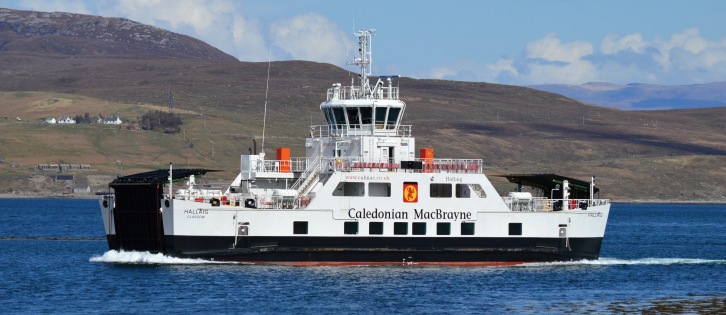
MV Hallaig, one of the CMAL hybrid ferries, approaching Sconser. Image by Imtech Marine Limits of AC grids
Therefore, using DC grids seems to be a logical solution. There is now a development going on with new DC grids that is set to change the way grids are designed and operated in the future. Newly developed “Current Routers” route the flow of energy in a way which is comparable to the flow of data in a data network. Moreover, these routers strongly limit the energy released in case of a short-circuit. If there is a problem, the faulty part is automatically isolated and the healthy parts are restored in a matter of milliseconds. Smart DC grid The introduction of communication between the Current Routers creates a fully controlled “smart” power system. Communication enables plug-and-play connection of components on any location and it facilitates automatic optimisation of the energy consumption, energy generation and energy storage, depending on the actual “optimisation goal”. The smart DC grid Imtech Marine is proposing uses power electronics and data communications to realise a fully controlled grid with very low short-circuit energy. In this grid not only the protection and the load control have been redesigned, but other aspects, such as grid architecture, voltage levels and EMC mitigations have been redesigned as well. The Current Routers integrate both the protection and load control functions. Basically, the Current Router decouples two power buses. A large amount of energy can therefore be stored on one bus - in a battery or a capacitor - while the other side can be a low stored-energy bus. Furthermore, the Current Router controls the load of its own connection. This means that bus sections can be created in which protection and load flow are controlled and isolated from the rest of the power system. This smart DC grid concept doesn’t have the limitations concerning the implementation of large-scale, power electronic converters, energy storages and alternative power sources of traditional AC and DC grids. Operational and economic advantages Current Routers allow a grid to be created with low, short-circuit energy that is fully controlled in terms of configuration and power routing. Peak loads are reduced by priority-based power routing, which results in a reduction in installed power and spinning back-up power. Furthermore, the Current Routers make implementation of self-restoring mesh or closed-ring distribution grids possible. On top of the operational advantages we foresee also economic advantages when compared to AC grids. The total power system volume, footprint and weight is reduced and power sources can be operated in their most efficient operation points. And most importantly, the safety levels for the crew, systems and the ship itself are increased. Profile Imtech Marine Imtech Marine (headquarters in Rotterdam) is a leading company in the global maritime market, operating as a full-service provider and system integrator of tailor-made, innovative and sustainable technology solutions covering the whole ship. Imtech Marine specialises in automation (platform and engine room), navigation, communication and connectivity solutions, propulsion systems, power generation and distribution, HVAC (heating, ventilation and air conditioning), ship motion control, information technology, entertainment and port services. Imtech Marine provides innovative systems and reliable maintenance services around the world during the full lifetime of the ship. The company employs approx. 2,475 staff at almost 100 offices in 30 countries, based along shipping routes and close to shipbuilding. Imtech Marine - press release |
