|
January 18, 2024
Phase 3 of EEDI*1 will require bunkers (no less than 20,000 deadweight tons), for which construction contracts will be concluded in 2025 or thereafter, to be 30% more efficient in CO2 emissions compared to the EEDI standards. In pursuit of a further reduction in the environmental burden through greater fuel economy, the new ship is expected to achieve a 40% improvement in CO2 emissions efficiency based on NSY's optimal ship development, including the newest main engine and the adoption of energy-saving accessories. Moreover, methanol-ready ship concept which assumes a shift toward methanol, a marine fuel with a low environmental footprint, will be adopted. Outline of vessel 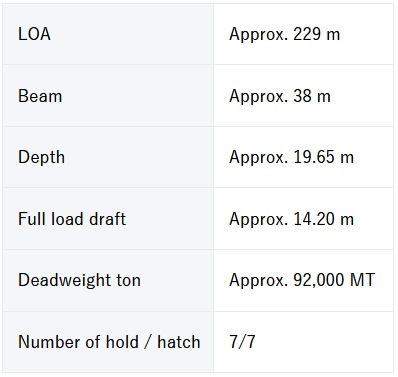
Under "K" LINE Environmental Vision 2050, a long-term environmental guideline *2 , "K" LINE has set a goal of improving CO2 emissions efficiency by 50% and achieving net-zero GHG emissions by 2050. As part of its associated action plans, it plans to implement a shift such as new highly eco-friendly fuels, the use of wind power propulsion systems. Going forward, "K" LINE will continue to strive to contribute to sustainable economic and social development and enhance corporate value while actively and flexibly responding to customers' needs, including environmental responses which are expected to grow, and preserving the environment through business activities based on the "K" LINE Environmental Vision 2050. *1 EEDI: Energy Efficiency Design Index. The EEDI estimates ship CO2 emissions when carrying 1 ton of cargo for 1 mile. https://www.kline.co.jp/en/sustainability/environment/regulation.html *2"K" LINE Environmental Vision 2050: Blue Seas for the Future https://www.kline.co.jp/en/sustainability/environment/management.html#002 Kawasaki Kisen Kaisha, Ltd. press release 
|
