 Maersk Line’s reefer containers gave access to new markets
23-Jan-2014
Agriculture amounts to half of Kenyan GDP and employs 75% of the Kenyan workforce, according to World Economic Forum. The shipping and logistics industry have played a vital role in enabling Kenyan farmers expand their markets resulting in a positive impact on the local economy. By use of Maersk Lines's reefer containers with special technology it has been possible to improve the transit time of e.g. fresh fruit.
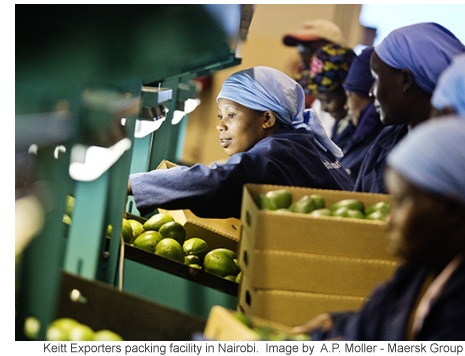 During the recent four years, the Kenyan avocado industry has seen an increase in potential transit time in reefer containers from 10 to 40 days making it possible to reach premium European markets - and avoid fast ripening.
Kenya is widely recognised as East Africa's economic powerhouse. Kenya also houses East Africa's busiest container terminal, the Port of Mombasa, which is the origin of a transport corridor transiting through Kenya to Uganda, Rwanda and the new state of South Sudan, linking some 200 million people, similar to the size of the population of Brazil, to the global markets.
Small fruit, big impact
 Joseph Githii is one of those successful Kenyan avocado farmers. Located just outside the small town of Kanjuku, 70 km from Nairobi, the 2.8-hectare property – which the man modestly calls his garden – forms an intricate system in which crops rotate, protecting the red soil and constantly making way for in-demand produce. In recent years, avocado trees have become more frequent.
"Avocados are more profitable than the other things I grow in my garden," he says and stops at an avocado tree. One of his grandsons climbs it and picks a fruit for him.
The tree will continue to grow fruit throughout the season, with the total yield reaching as many as 5,000 avocados. What began 20 years ago as a hobby and two trees has now turned into more than ten trees and a steady stream of income.
|
|
Maersk Line's reefer containers opened up the market
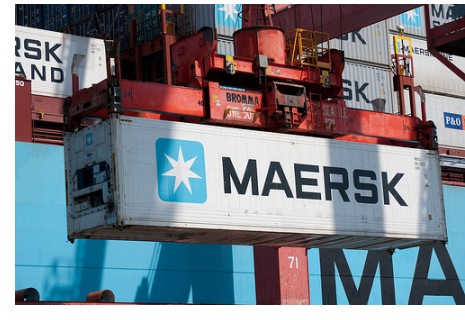
Kenya's avocado was not always this appreciated. The introduction of Maersk Line's Star Care reefer container four years ago, however, fundamentally changed its fate. Before, the Middle East was the end of the line. Now, Europe, where the fruit would sell for roughly triple the price, was within reach.
According to Beth Wanjiku Ihomba, a Maersk Line sales executive, the industry players were excited yet sceptical at the outlook.
"To win them over, I encouraged them to ship one container to Europe," Beth Wanjiku Ihomba recalls.
"Anyone could put a pallet in the container. We sealed it and carried it to Europe on a no-cure-no-pay basis. Our promise was that if the fruit went bad, no one would pay a cent."
Around 15-20 exporters went along, and a container was shipped to Belgium. It arrived, was opened and the buyers liked what they saw - the fruit sold at premium rates. A second trial was shipped to Rotterdam, under the same terms and with the same result. The exporters and farmers were convinced.
"From then on it was good times for all in the industry," says Beth Wanjiku Ihomba.
"The world market has opened up to us thanks to Maersk Line's reefers. Ten days used to be the limit. Now we can carry the fruit for 25 days to Europe, and even 40 days to Russia. During July's peak season each container will be carrying up to 100,000 avocados. Without those reefers we would be doing something else," says Peter Nderu, a director and partner at Keitt Exports in Nairobi.
Small scale farmers with great impact on local economy
Within the next ten years, new avocado fields are expected to more than double Kenya's current production of avocados, and small-scale farmers will be the main driver.
This development is nothing new to Beth Wanjiku Ihomba at Maersk Line. After introducing the Star Care reefer, her visits to farmers and exporters by the hundreds have seen Maersk Line taking the lion's share of the market.
"We want to be first wherever avocados are grown. We tie up everything with the exporters, we partner with farmers, and we help with the technology. What we realised is when you begin with someone when they are just starting up, they stay with you forever," Ihomba says. June of 2013 saw another milestone, as she arranged the first five reefers with avocados from Moshi in Northen Tanzania. The buyers in Europe were delighted with the fruit.
"If Tanzania comes on board, we would be doing two seasons, and believe me, we could easily more than double our volumes and hit 2,000 reefers," Beth Wanjiku Ihomba says.
Passing it on
While Joseph Githii is preparing for the next visit from the avocado broker, he also has the next generation in view, passing on the skills:
"One of my daughters saw what I was doing, and she took two seedlings. She planted them, and now she makes money. Her three daughters are in secondary school," he says.
He examines the quality of the avocado in his hand. In a few weeks it might be on the shelf of a greengrocer in the Netherlands.
Maersk Line has the largest fleet, including the newest state of the art reefer containers, as well as the most comprehensive global network. Special features include:
• Super Freezer™ technology - provides temperature management down to -76°F / -60°C.
• StarCare™ and StarFresh™ - providing controlled atmosphere service, for a better quality product and a prolonged shelf life for a wide range of chilled commodities.
• Magnum™ reefer technology – able to accurately maintain -31°F / -35°C.
• Cold Treatment Service - some countries require special treatment of chilled produce, before entering their borders or port facilities.
• Shipping refrigerated cargo can be 25 times more CO2 efficient than moving it by air.
Facts about Kenya
Full name: The Republic of Kenya
Population: 42.7 million (UN, 2012)
Capital: Nairobi
Area: 582,646 sq km
Major languages: Swahili, English
GNI per capita: US $820 (World Bank, 2011)
Throughput at the Port of Mombasa, Kenya's main port, in 2012: 899,000 TEU
A.P. Moller - Maersk Group, press release