|
The Castillo de Santisteban recently passed extensive gas and sea trials before the hand-over to its owner. Its entry into active service represents a milestone for MAN Diesel & Turbo in that the order for the ship’s dual-fuel engines, registered in 2007, was the very first received for this engine type. The engine is especially designed for propulsion systems for LNG carriers and gas-fuelled ships, and focuses on the safety requirements stipulated by classification societies for gas operation. The LNG Carrier’s new propulsion system is designed to give the vessel a higher degree of redundancy in terms of maintenance while sailing, and takes advantage of the 51/60DF engine’s multiple fuelling options, MAN Diesel & Turbo states. The 8L51/60DF engines were built at MAN Diesel & Turbo’s own works in Germany. They can run on gaseous (for example, vaporised LNG) or liquid fuels of a wide range of qualities (HFO/MDO/MGO) and have low emission levels. At 1.5 g/kWh (IMO cycle E2) in gaseous-fuel operating mode, the 51/60DF already complies with future IMO Tier-III limits for NOx by a considerable margin without the need for exhaust-gas treatment or any other countermeasures. The MAN 51/60DF engine MAN Diesel & Turbo’s 51/60DF dual-fuel engine offers a market-leading 1,000 kW/cylinder output at 514 rpm for 60-Hz generator sets in both its gaseous and liquid-fuel operating modes. For marine applications, it is offered in inline versions with 6, 7, 8 and 9 cylinders and V- configuration versions with 12, 14, 16, and 18 cylinders in a power range from 6,000 to 18,000 kW. MAN’s new engine model uses the ‘common-rail’ micro-pilot fuel-injection system for liquid fuel that is necessary when running on gas to ignite the air-gas mixture. This system ensures independent control of injection timing, injection pressure and injection volume. When running on liquid fuel, the 51/60DF works with a conventional fuel-injection system, injecting the fuel oil through a separate main fuel injector in a camshaft-actuated pump-line-nozzle system. The fuel injection control is integrated within the engine’s SaCoSone (Safety and Control System). SaCoSone The SaCoSone safety and control system allows safe engine operation in both liquid and gas mode with optimal fuel consumption and exhaust-gas emissions. In gas-mode, the system controls the various parameters for each cylinder independently, including air/fuel ratio, load, valve timing, pilot-fuel injection and charge-air temperature. This facilitates an optimal combustion while allowing operation within a wide range of the air/fuel ratio and avoiding incomplete-ignition failures, misfiring and knocking. About Elcano Empresa Naviera Elcano, S.A is based in Madrid and engaged in the shipping of bulk products, both solid – such as coal, ore and grain – and liquid – such as LNG, LPG, oil, oil products and chemical products. The Spanish company is the parent of an international shipping group with subsidiaries in Spain, Portugal, Brazil, Argentina among other countries. Elcano was founded in 1942 and manages its own fleet of 27 vessels. MAN Diesel & Turbo, Press Release |
 MAN Diesel & Turbo Scores Significant Dual-Fuel Reference
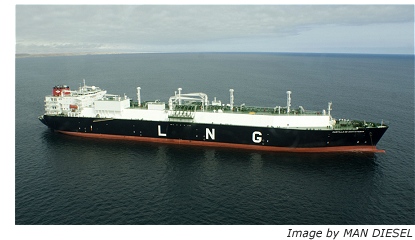 STX Offshore & Shipbuilding, the South Korean shipbuilder, recently delivered the ‘Castillo de Santisteban’ to Empresa Naviera Elcano, the globally active Spanish shipping group. Five MAN dual-fuel 8L51/60DF engines will power the 300-metre long LNG carrier with each delivering 8,000 kW at 514 rpm. The newbuilding has been assigned by her charterer, Spanish energy company Repsol – Gas Natural LNG (Stream), to the Peruvian Camisea/Pampa Melchorita gas project, the first natural-gas liquefaction plant in South America. The carrier has a carrying capacity of 173,600 m3 LNG.