|
Since its launch in 1988, MAN Diesel & Turbo has sold nearly 800 × 48/60 units, bound for a broad range of power-generation and marine-propulsion applications. Thanks to its high efficiency, the 18-cylinder variant is the 48/60 engine family’s bestselling configuration. The overall design of the two-stage turbocharged 18V48/60TS has been kept as simple as possible and differs in the form of just a few modifications from the standard engine. These include: • modified fuel-injection nozzles for the higher power-output range • a three-ring piston with higher compression ratio • a modified camshaft for enhanced Miller timing • an additional exhaust-gas bypass valve to avoid smoke during start-up. The high-pressure turbocharger is directly mounted to the engine with the lowpressure turbocharger located upstream on its own steel frame. The combustion-air and exhaust-gas piping between both turbochargers is fitted with compensators, ensuring complete insulation from vibrations. Lowest fuel-oil consumption or NOx emissions The excess combustion air from the turbochargers provides greater operational flexibility. The high charge-air pressure can be used for enhanced Miller Cycling, delivering significant fuel savings. Alternatively, it can be leveraged to significantly increase engine power-output while, simultaneously, further reducing NOx emissions. At the power output of 1,050 kW/cylinder, the 18V48/60TS diesel engine has a very low specific fuel-oil consumption of 171.1 g/kWh, referenced to engine power output without engine-mounted pumps, at ISO 3046 conditions with a tolerance of 5%. This is equivalent to a heat rate of 7,305 kJ/kWh or a pure engine efficiency of 49.2%. Referenced to an electrical genset power-output, assuming a generator efficiency of 97.5% and with engine-mounted pumps, the heat rate emerges as 7,607 kJ/kWh or 47.3% electrical genset efficiency. This is an efficiency rate for four-stroke diesel engines, which makes the two-stage turbocharged 18V48/60TS one of the most costeffective diesel engine in its class. The excess combustion air can alternatively be leveraged to significantly increase the engine’s power output up to 1,200 kW/cylinder. Although this does not save fuel, it does allow for a greater reduction of NOx emissions within a wide operation range. NOx emissions of 1,480 mg/Nm³ make the 18V48/60TS one of the cleanest diesel engine in its power range. Flexibility Like the standard engines in the 48/60 series, the two-stage-turbocharged 18V48/60TS can be operated with a wide range of different fuels, including: • heavy fuel oils with a viscosity up to 700 cst • marine diesel and gas oil. Two-stage turbocharging enables the 18V48/60TS to operate continuously at shaft power outputs from 18,900 up to 21,600 kW. In a stationary-power scenario, for example, this would allow power providers to operate engines at a normal load of 18,900 kW, taking advantage of the extremely low fuel-oil consumption and allowing the possibility of a spinning reserve up to 21,600 kW. Two-stage turbocharging technology The advanced technology offered by two-stage turbocharging enables the 48/60TS to reach the highest possible performance in the market. The new engine’s design arranges two turbochargers in series, allowing very high combustion/air-pressure ratios that open up a whole new dimension of operational possibilities. The 18V48/60TS deploys MAN Diesel & Turbo’s tried and tested TCA88 and TCA77 standard turbochargers in sequence. The TCA88 is located upstream and provides the low-pressure turbocharger, while the TCA77 forms the high-pressure turbocharger, next to the engine. In this configuration, both turbochargers can achieve pressure ratios in the range of 6 bar at significantly higher efficiencies compared to a single-stage turbocharged system. Despite the two-stage turbocharger modular system being an engine add-on, the 48/60TS does not require any more space than an engine with a single-stage turbocharger system. The engine features an uncomplicated design where all components are easily accessible for maintenance despite the compact design. 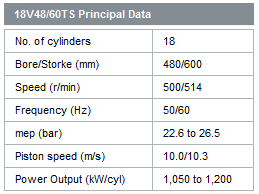
MAN Diesel & Turbo, Press Release |
 MAN Diesel & Turbo Launches Two-Stage Turbocharging
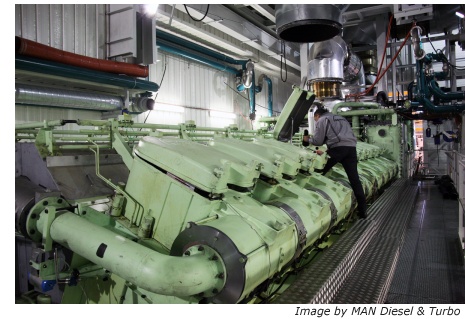 Uniquely, MAN Diesel & Turbo is the only engine builder that develops and builds its own turbochargers for large diesel engines, an unique expertise that translates into exceptional efficiency and reliability. Two-stage turbocharging is a modular system whose design enables retrofitting at most MAN Diesel & Turbo 18V48/60 power plants.