|
Hyundai’s full-scale demonstration of the ME-GI principle is based on the temporary conversion to ME-GI of an existing production engine – an MAN B&W 8S70ME-C type – generously placed at its disposal by Frontline, the prominent Norwegian shipowner. MAN Diesel & Turbo reports the demonstrations as stemming from customer requests to employ the ME-GI engine in new projects and states that production capability for the ME-GI is already available. The ME-GI engine Unveiled at a major event at MAN Diesel & Turbo’s Copenhagen Diesel Research Centre in May 2011, the ME-GI engine represents the culmination of many years’ work that began in the 1990s with the company’s prototype MC-GI dual-fuel engine. The first two-stroke GI engine, a 12K80MC-GI-S, entered service at a power plant in Chiba, near Tokyo, Japan in 1994. Mitsui reported adopting twin ME-GI engines as prime movers aboard its concept LNG carrier ‘Double Eco MAX’ in July 2011, a move intended to realise a 30% reduction in fuel costs and CO2 emissions. Similarly, major yards in Korea, Japan and China have, or currently are, developing such concepts. Depending on relative price and availability, as well as environmental considerations, the ME-GI engine gives shipowners and operators the option of using either HFO or gas – predominantly natural gas but also, eventually, LPG. MAN Diesel & Turbo sees significant opportunities arising for gas-fuelled tonnage as fuel prices rise and modern exhaust-emission limits tighten. Indeed, previous research indicates that the ME-GI engine delivers significant reductions in CO2, NOx and SOx emissions. MAN Diesel & Turbo predicts a broad, potential market for its ME-GI engine, extending from LNG and LPG carriers to other oceangoing vessel segments such as containerships as well as ships plying a fixed trade. As such, the ME-GI engine represents a highly efficient, flexible, propulsion-plant solution. Technical presentation findings The ME-GI Concept features dual-fuel operation modes with: • no knocking • no unintentional gas injection • no escape of gas to crankcase or engine room • no methane slip. Benefits to the owner include: • full power & performance • full load response • nbsp;full fuel flexibility (Tier II/Tier III) • gas quality flexibility • port-to-port gas-mode operation • fully integrated control system. Origins MAN Diesel & Turbo’s MC/ME engine family has been on the market since 1982 and seen service in almost every type of marine application on container vessels, tankers of all sizes, bulk carriers, car carriers, RoRo and general cargo vessels. As such, the MC/ME engine is a well-proven product in the industry while the GI (Gas Injection) solution was developed in parallel and finished for testing in the early 1990s. Technically, there is very little difference between fuel-oil and gas-burning engines, but the GI engine provides an optimal fuel flexibility. Conclusions The technical presentation’s main points, as revealed at the Hyundai event, can be summed up as thus: • ME-GI concept re-confirmed • layout of S70ME-GI verified • safety procedures verified • performance and efficiency increased • low emissions maintained • ME-GI engine manufacturing confirmed • test facilities available • ME-GI is ready for orders • pertaining auxiliary equipment readily available. MAN Diesel & Turbo, Press Release |
 Engine of the Future is Already Available
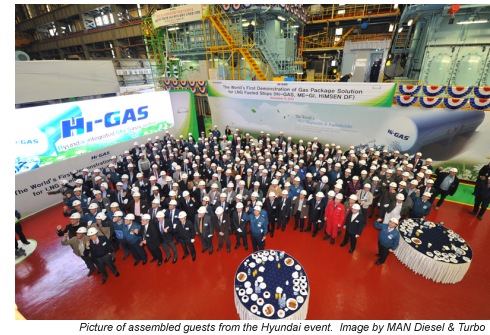 At a large customer event in Korea on 9 November 2012, Hyundai revealed the first, commercial MAN B&W ME-GI engine. The ME-GI is a gas-injection, dual-fuel, low-speed diesel engine that, when acting as main propulsion in LNG carriers or any other type of merchant marine vessel, can burn gas or fuel-oil at any ratio, depending on the energy source available on board and dictated by relative cost of combustibles and owner preference.
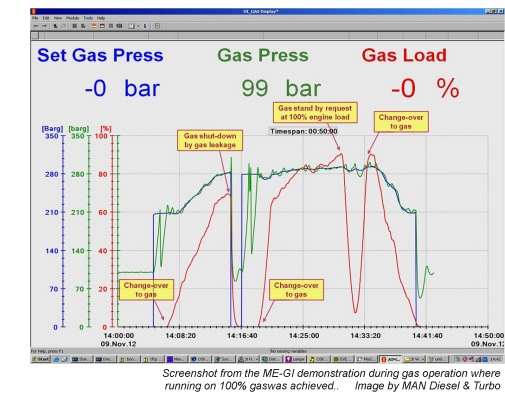 In his speech at the ceremony, Ole Grøne – Senior Vice President Low-Speed Promotion & Sales, MAN Diesel & Turbo – said: “In spite of the fact that newbuilding activity presently is relatively low, the regulatory environment of shipping is being tightened, especially with a view to emission control. Hence, development activities are high and HHI’s commitment to work with MAN Diesel & Turbo towards this demonstration of the ME-GI principle on a real commercial engine is highly appreciated by the industry. In this context it should be noted that the ME-GI technology is retrofittable for all existing ME engines.