|
Reducing CO2 Emissions and Costs Offloading Crude Oil from Sub-bed Oil Fields Tokyo - March 06, 2024
SeaLoading started a CTV agreement with Petrobras for SeaLoader 2 on a trial period in January 2022, and successfully completed more than 30 crude oil offloading operations from Petrobras' FPSOs located in the Santos Basin, Brazil, transferring the cargo to tankers - the trials involved vessels up to VLCC size. After the successful conclusion of the trial agreement, proving the CTV technology efficiency and reliability, the vessel was placed on a time charter contract in 2023 with Petrobras. Now SeaLoading has signed a memorandum of understanding (MoU) with Petrobras to start the negotiations for a newbuilding CTV by the end of 2024. The crude oil produced from offshore fields by a floating production, storage & offloading system (FPSO)(Note 2) is usually transported to the demand area via crude oil tankers, which, in most cases, requires DP shuttle tankers(Note 3) with special cargo handling equipment firstly receive the crude oil and transport it to an oil storage terminal or calm waters where it can be offloaded (or transshipped), and then reloaded onto a crude oil tanker. In the case of CTV, the crude oil can be directly loaded from the FPSO to the crude oil tanker by connecting a CTV between an FPSO and the crude oil tanker. This dramatically increases the efficiency of crude oil logistics. Currently, there are only 2 two CTVs in the world, all owned by SeaLoading, which holds the patent for the CTV technology. 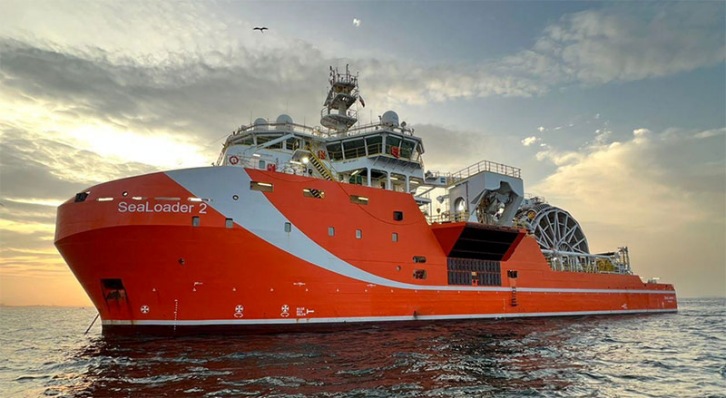
SeaLoader 2. Image by MOL. Comparison of Shuttle Tanker and CTV Crude Oil Supply Chains 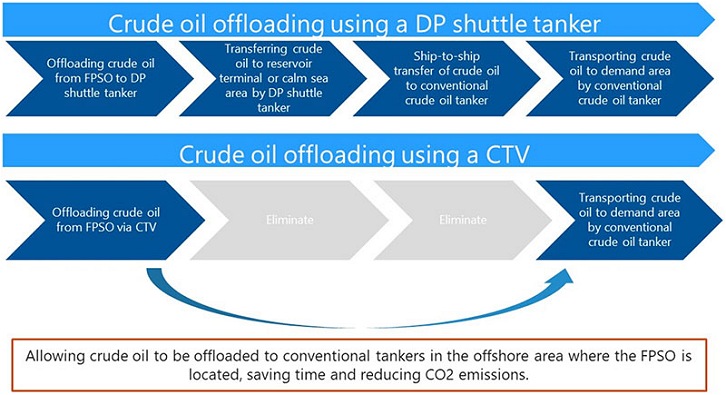
Schematic diagram and photo of cargo handling with CTV 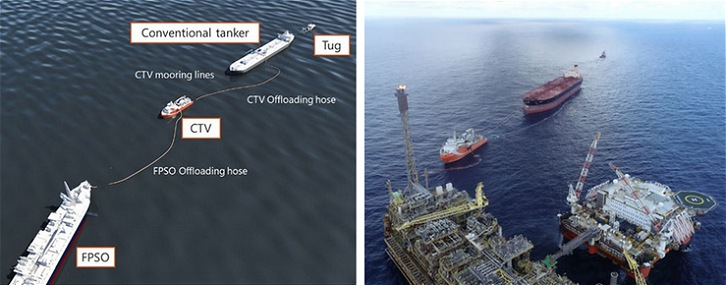
Image by MOL.
The MOL Group is strengthening its collaboration with Petrobras and other oil majors, with the aim of further spreading the use of CTVs in the future, a move that can significantly reduce CO2 emissions and costs compared to conventional crude oil transfer by DP shuttle tankers, and will continue to improve efficiency and reduce environmental impact in the supply chain from crude oil production and storage to offloading. (Note 1) SeaLoading MOL acquired 100% of SeaLoading's shares in 2022 after entering the CTV business in 2019. Head Office: Arendal, Norway Established: 2014 Representative: Yoshiro Kubo Business: Own, market and operate 2 CTVs (Note 2) FPSO: Floating Production, Storage & Offloading Systems Oil reservoir fluids extracted from deep-sea oil fields are brought into an FPSO and separated into crude oil and gas by processing equipment on deck. Treated crude oil is transferred to the cargo tanks in the FPSO's hull, and regularly offloaded onto shuttle tankers. Treated gas is used as fuel for the FPSO. It is also transported to shore via pipeline or re-injected back into oil wells. This entire series of operations is performed aboard the FPSO. Many FPSOs are converted second-hand oil tankers. The mooring equipment, production equipment, offloading equipment, and so on are installed on the FPSO after hull reinforcement. 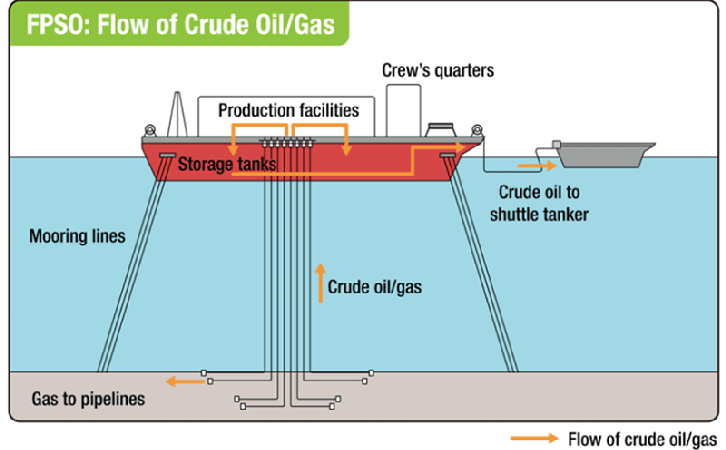
(Note 3) DP Shuttle tankers Shuttle tankers transport crude oil from FPSOs or other offshore production facilities to onshore terminals. These tankers are equipped with dynamic positioning systems (which electronically control the ship's maneuvering to maintain its position), offshore loading equipment mounted on the bow, and so on to ensure safe loading operations without anchoring, even under severe sea, weather, and tide conditions. Mitsui O.S.K. Lines, Ltd. press release 
|
