|
LNG-fueled Tugboat Ishin Supports Launching Operations Tokyo - September 04, 2024
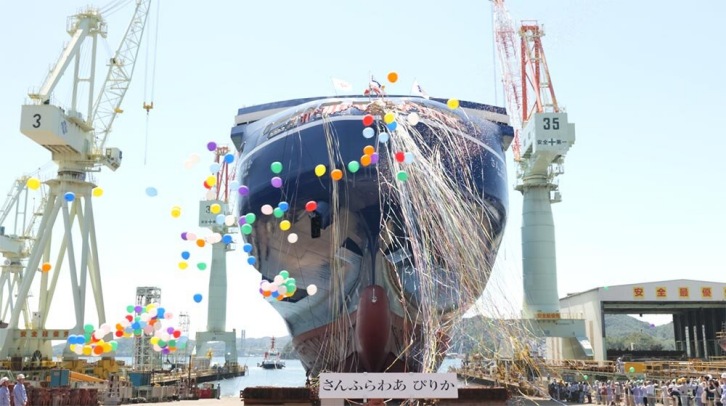
At the ceremony. Image by MOL.
With the newbuilding ferry, the Sunflower Kurenai and Sunflower Murasaki already in service on the Osaka-Beppu route since 2023, and the sister ship Sunflower Kamuy, which is scheduled to enter service in early 2025 as the first ship on the Oarai-Tomakomai route, the MOL Group will operate a fleet of 4 LNG-fueled ferries on East-West routes in Japan. Boasting Japan's largest service route network and the most LNG-fueled ferries in operation, the group offers stable services in both logistics and passenger services. MOL Sunflower as a whole operates 10 ferries and 5 RORO vessels on 6 routes giving the company the Japan's largest ferry fleet and most extensive route network, offering reliable service for both logistics and passengers. About the Sunflower Pirka • Origin of the name Showing reverence for the Ainu people, the great ancestors of the northern part of the Japanese archipelago, especially Hokkaido, the name of the vessel for a new era, the new LNG-fueled ferry, is an expression of its commitment to tradition and the future. It was also a conscious decision to evoke the image of Hokkaido, as a calling port. The word "Pirka" means "beautiful," "nice," and "rich" in the Ainu language, and the new ferry was named in the hope that it will connect communities and people for a long time and continue to illuminate a bright and beautiful future. While the Sunflower Kamuy and Sunflower Pirka will have the same hull design and concept, each will have a different interior design with different features to heighten the anticipation of the journey. • Performance of the ferry The ferry will be able to reduce CO2 emissions by about 35% compared to vessels currently serving on the Hokkaido route, thereby contributing to the reduction of CO2 emissions in society as a whole, by adopting the Ishin hull form, which can use oblique headwinds as propulsion, and various other state-of-the-art technologies, such as energy-saving devices developed by Naikai Zosen, all of which will be adopted in addition to the installation of high-performance engines that use LNG fuel. The ferry will also support Japan's Modal Shift and solve the "2024 logistics problem" by providing more space for trucks than current vessels and more comfortable space for truck drivers by making all cabins private rooms. 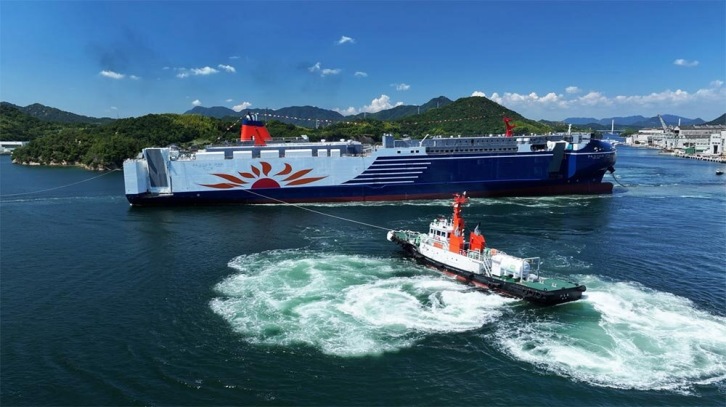
The LNG-fueled ferry Sunflower Pirka and LNG-fueled tugboat Ishin. Image by MOL. About the LNG-fueled tugboat 'Ishin' Owned by MOL and operated by Nihon Tug-Boat, this LNG-fueled tugboat is a pioneer in LNG-fueled vessels and was delivered in February 2019. MOL has built a number of LNG-fueled vessels by leveraging the knowledge and expertise gained through the development and operation of the Ishin, and this knowledge is greatly utilized on the newly launched LNG-fueled ferry Sunflower Pirka. The towing of the ferry by the Ishin for the launching ceremony was a symbolic operation that passed the baton of knowledge accumulated thus far to the next generation. The MOL Group aims to achieve net zero greenhouse gas (GHG) emissions by 2050, and will continue to pursue its "Adoption of Clean Alternative Fuels" strategy to achieve decarbonization and low carbon emissions in line with the "MOL Group Environmental Vision 2.2." The group will lead the way in environmental responsiveness in the coastal ferry business, and continue to research and examine the use of new fuels as alternatives to LNG in the future, to actively lead the industry. 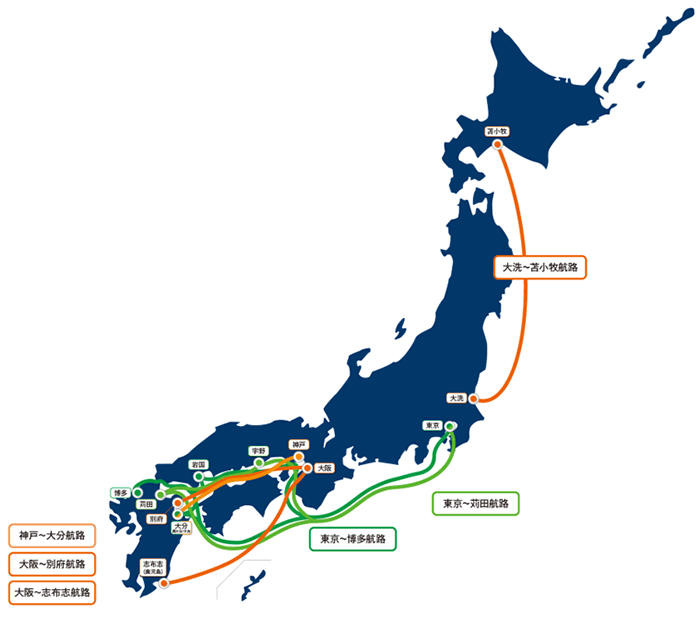
MOL Sunflower service routes. Image by MOL. Mitsui O.S.K. Lines, Ltd. press release 
|
