|
Solitaire will construct 227 of the 375 kilometres of the Finnish section of the pipeline. This vessel started laying pipe in Russian waters in the beginning of September and has so far laid approximately 120 kilometres of the pipeline. Three pipe carrier vessels will tranship the pipe joints to Solitaire from Kotka, where they were concrete weight coated in EUPEC´s factory, and the Hanko Marshalling Yard. Safety of marine traffic taken into account Mariners will be informed in advance of all construction-related activities (Notice to Mariners), and there will be warnings in the affected areas through the NAVTEX (Navigational Telex) system and through VHF security broadcasts. All vessels used in the Nord Stream project will follow the COLREG regulations by the International Maritime Organization (IMO) to prevent vessels from colliding. Safety zones will be set up around the vessels used in the construction works. The safety zones will be closed to other traffic during the operations. The safety zone around the Solitaire is two kilometres. In addition for pipelay within the Kalbådagrund traffic separation scheme (TSS) and the Porkkala TSS, there will be a dedicated intervention tug stationed in the area. This tug will be available to assist any vessel that may lose its capability to maneuver and lead to a potential risk to the maritime environment. The intervention tug would be available to act under the instruction of MRSC Helsinki. Construction proceeds as planned Already nearly 500 kilometres of the first pipeline have been constructed in Swedish, German, Russian and Finnish waters. Saipem´s Castoro Sei laid about 150 kilometres of pipe during summer and early autumn in the westernmost part of the Finnish EEZ. Both of the twin pipelines have already been constructed and pulled ashore at the Russian landfall in Portovaya Bay near Vyborg, and at the German landfall in Lubmin, near Greifswald. Nord Stream’s twin pipelines will be 1,224 kilometres long and consist of altogether 202,000 concrete weight coated pipes, each 12 metres long and weighing approximately 23 tons. When both lines are completed in 2012, they will transport 55 billion cubic metres (bcm) of natural gas per year - enough to meet the needs of more than 26 million European households. Nord Stream AG, press release |

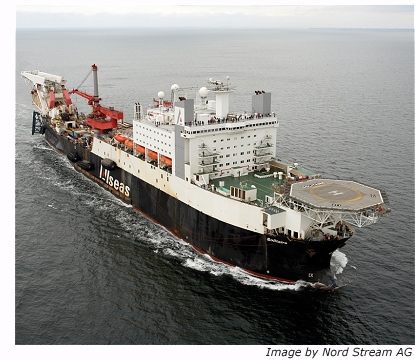 Construction of the Nord Stream pipeline will resume in the Finnish section of the route as the pipe-lay vessel Solitaire is scheduled to enter the Eastern part of the Finnish Exclusive Economic Zone (EEZ) on Thursday 21 October. Solitaire will construct the majority of the Finnish section of Nord Stream during autumn 2010 and early 2011.