|
Global Logistics Business There are two types of non-shipping business. First, business that literally has nothing to do with shipping. The second type concerns the intangible or conceptual aspects of shipping: in other words, how to improve the existing shipping business. Of the first kind, the most important business is our logistics business. Amid intensified and inevitable competition in the liner sector, which has seen the greatest gap between supply and demand, we have been concentrating our efforts in the logistics business as a way to differentiate ourselves from our competitors in land transportation. We believe that our logistics business will be able to capture all the transportation needs of our clients, while promising significant growth, particularly in Asia. However, recurring profit, which had reached ¥9.2 billion in fiscal 2011, fell sharply to ¥4.7 billion in fiscal 2012, and further dropped to ¥0.5 billion in the first quarter of the current fiscal year. The major reason for this rapid deterioration in profit is attributed to the steep decline in air cargo exports from Japan, which had previously been seen as a strength of the former Yusen Air & Sea Service Co. Ltd., plus the burden of initial investments required to expand the non-vessel operating common carriers (NVOCC) business – one of the weaknesses of the newly established Yusen Logistics Co. Ltd. Nevertheless, a major turnaround has been achieved and a recurring profit of ¥2.4 billion was posted in the second quarter. This was due in part to the slight improvements in air cargo exports from Japan but also to profits generated by major increases in NVOCC business volumes. In order to become an international forwarder, we must be equipped with the three basic functions: 1.air freight forwarding; 2.NVOCC (ocean freight forwarding); 3.contract logistics including delivery, warehousing, and customs clearance. Yusen Logistics has firmly established these three functions. Looking to the future, Yusen Logistics is expected to increase its growth by leveraging contract logistics, a great advantage in Asia, and will benefit from the synergy resulting from the integration of Yusen Air & Sea Service and NYK Logistics to become one of the core businesses of the NYK Group. Many sources for differentiation in the logistics business are found in the contract logistics area. This involves seeking out the 3 M’s in the client’s logistics, and improving and resolving them by using IT. Therefore, strengthening our ability to propose and deliver improvements will be an integral part of our future growth. Our auto logistics business, including terminals for automobiles and inland transportation, was originally considered as a means to secure ocean transportation contracts and as a complementary service for reducing costs. Now, it is a revenue-generating profit centre in its own right and has become an indispensable part of the business. Intangible Aspects of Shipping The main focus of “More Than Shipping 2013” was, in fact, on the intangible or conceptual aspects of shipping – looking at how we could add value to the existing conventional shipping business. With the rampant commodification of most types of vessels, we needed to figure out a way to differentiate ourselves from the competition and maintain a certain level of profits in what is, without doubt, the main battleground of our business. Our solution was to use the same vessels but transport goods in a safer, more dependable, yet cheaper way than competitors. To ensure safety and dependability, an uncompromising stance toward safety and dependability has to be adopted at every site. To achieve cheaper transport, we should use a vessels free of 3 M’s (muda, mura and muri), leveraging our operational expertise, technical capability and sales strategy. In other words, our success depends on our gemba or front-line capabilities. The human abilities of integrity, innovation and intensity are the drivers behind our gemba capabilities, the intangible aspects of our business that I have been emphasising all along. Fuel-saving activities, epitomised by the IBIS Project that addressed the NYK Group’s ultimate muda of surplus vessels and massive consumption of expensive fuel, have become embedded in our everyday work. These activities are of paramount importance and have been producing significant results. Moreover, the group’s technical team has given strong support to our activities. This is typified by our vessel Soyo, which had its fuel-efficiency enhanced massively with an air-lubrication system. Reducing the 3 M’s has also produced major results in an increasing number of other areas too. One such example is the EAGLE Project for the liner business. The project, which treats each container as a vessel, minimises empty container movements and charges appropriate freight fees on cargo going to destinations where an empty container movement on the return voyage cannot be avoided. This project has already begun to produce impressive results. As I mentioned earlier, IT back-up and the strong determination of everyone involved to reduce the 3 M’s has been essential to this project. Crystal Cruises Inc., engaged in the cruise business mainly in the U.S. and European markets, has also begun to deliver impressive results. Because Crystal Cruises offered top-of-the-line cruises, price structures were not flexible. In addition, due to the global recession and sluggish economy in Europe, voyages frequently had low occupancy, resulting in a surge in vacancy rates – a classic example of muda. Crystal Cruises had been suffering major setbacks in its revenues until the previous fiscal year. Our solution to this situation was to make a significant change in our sales policies, including the adoption of an early-bird discount reservation system and at the same time increasing prices for last-minute reservations on popular cruises. As a result, both the occupancy rates and sales have recovered, securing a return to profitability in the current fiscal year. Furthermore, the Capesize bulker and VLCC fleets that had contained surplus vessels have also been steadily increasing their business, thanks to an accumulation of long-term contracts won through successful collaborations with partners in Asia and emerging countries. This ends my summary of the progress we have made in “More Than Shipping,” and I would like to say that I truly appreciate the effort made by each division in this initiative. However, we must also bear in mind that the true drivers of this progress have been our maritime technologists. Their great integrity, innovation and intensity have ensured the safety and dependability of our operations, forming the very backbone of our shipping business. We must also remember that it was the feedback from gemba (front-line sites) that allowed us to improve and add greater sophistication to our fuel-saving and safety capabilities. Human Abilities Put simply, “More Than Shipping” has been a project for demonstrating our human abilities. As I have repeatedly emphasised, the majority of the world’s ships are built in Japan, Korea and China, and differentiating ourselves from our competition in terms of the tangible aspects of shipping has become increasingly difficult. Today’s commodification of the shipping business will lead to what I call a “red ocean” where rampant, cut-throat competition to lower prices will become a norm. Therefore, the path we should follow lies in the higher road above our competitors, creating a “blue ocean.” We will differentiate ourselves from the competition by thoroughly eliminating muda, mura and muri, enhancing our competitive edge, honing our skills for proposing improvements based on our experience and knowledge, and providing added value. We have proven that we are certainly “More Than Shipping,” and I am proud of our accomplishments so far. Therefore, I would like to take this opportunity to reiterate my appreciation to you for demonstrating your human abilities. Going forward, I would like to ask you to further enhance those abilities by cultivating the creativity that makes you innovative and able to think outside the box. Develop your skills for proposing improvements based on a heightened awareness of the issues, develop your ability to come up with solutions, and develop your management skills to create healthy teamwork and good leadership so that we can join hands to cultivate a big “blue ocean.” Corporate Affairs and Compliance Before I finish my address, I would like to say a few words on the issues surrounding antitrust law. The shipping industry continues to operate in a complicated environment in which businesses that are subject to antitrust law exist side-by-side with those that are not. However, the current trend seems to be toward narrowing the range of businesses exempted from the application of antitrust law. Under such circumstances, it has become increasingly important for us to clearly understand the content of antitrust law and tendency to strengthen governmental regulations that subject businesses to these laws. Moreover, we need to be aware of the scope of business subject to such regulations. Similarly, for us to effectively compete, it is just as important to understand which businesses, or part of businesses, are not subject to such regulations. To address this situation, we have taken various measures, including the establishment of an executive committee to oversee antitrust law compliance, and all of us at the NYK Group must redouble our efforts to ensure antitrust law compliance in all aspects of our business. Finally, I would like to conclude by offering my sincere wishes for the good health and prosperity of all of you and your families. NYK Line, press release |
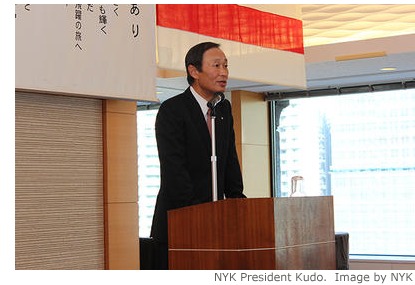
 New Year's Greetings from President Kudo
 I am also pleased and encouraged by the rapid expansion of our offshore-related businesses (one of our “More Than Shipping” businesses) and their contribution to profits.