|
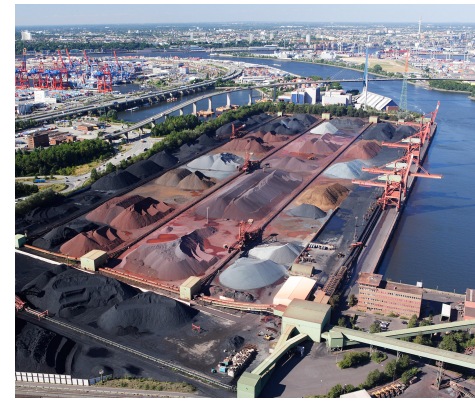
Throughput of non-containerized general cargo in 2013 totalled 1.9 million tons and was therefore 7.6 percent lower. The decline is primarily attributable to lower import volumes ( 19.3 percent). Imports of citrus fruits are increasingly containerized, causing a downturn in the volume of conventional cargoes handled. At 1.3 million tons, in 2013 exports of conventional general cargoes via Hamburg remained all but stable (- 1.4 percent). Along with project cargoes from the machinery and plant sector, among exports it is primarily vehicles, iron and steel, paper and timber that are handled conventionally. Bulk cargo throughput in 2013 rose by 7.2 percent to altogether 42.3 million tons, also contributing significantly to the Port of Hamburg’s favourable result on the year. In all three handling segments, namely grab, suction and liquid bulk cargoes, an increase in seaborne cargo handling was achieved. Suction cargo throughput advanced especially strongly, with handling of 8 million tons representing a 29.9 percent increase. Another advance was achieved in liquid bulk cargo, up by 3 percent at 14.5 million tons. Here the main source of growth was an above-average 65.7 percent leap to 7 million tons in imports of mineral oil products. Handling of grab cargoes, e.g. coal, ore, fertilizers and building materials, also improved significantly by 3 percent, reaching a total for the year of 19.7 million tons. Baltic region sustains growth Hamburg‘s container services with the Baltic region are the main growth factor in the European trades. In 2013 a total of 2.3 million TEU (+10.1 percent) were handled via Hamburg on feeder and shortsea services between Hamburg and ports on the Baltic. “Consisting of Russia, Finland, Poland, Sweden, the Baltic states and Denmark, the Baltic region is of immense significance for us in container traffic. We are surprised that despite clearance problems at the Kiel Canal, with 2.3 million TEU we were able to achieve such a good result for 2013,” said Mattern. Against the background of growing traffic flows, modernization and expansion of this waterway is in the view of both HHM’s Executive Board members of pre-eminent importance for Hamburg and the entire North German region. To further expand the links to this region, among other measures HHM has headed the EU-backed Amber Coast Logistics (ACL) project since February 2012. “We are delighted that high-ranking political representatives – also including Uwe Beckmeyer, the Federal Government’s new Maritime Coordinator – are participating today in the ACL closing conference being held in parallel at Unilever House in Hamburg’s HafenCity,” reported Egloff. 19 partners from Denmark, Poland, Latvia, Lithuania, Belarus and Germany are participating with the goal for ACL of promoting multimodal transport links in the southern and eastern region adjacent to the Baltic. “By building up cooperation across national frontiers we have been able to lay an important foundation stone towards making a sustained improvement in accessibility, especially in rural areas as well,” continued Egloff. Good results in the most significant trades Container services with Asia picked up again in 2013, with 4.9 million TEU (+ 3 percent) being handled in Hamburg in the form of imports from, or exports to, Asia. At 2.2 million TEU (+ 5.1 percent), exports, especially, produced distinct growth. On the import side, 2.7 million TEU (+ 1.4 percent) were handled in Hamburg. With a volume of 3.4 million TEU on Port of Hamburg container services, the East Asia trade with the People’s Republic of China and Hong Kong established itself as the port’s leading market region for container throughput. Container throughput with the People’s Republic of China and Hong Kong represented around 29 percent of the Port of Hamburg’s container throughput, reaching volume handled in 2013 of 2.7 million TEU (+ 2.9 percent). Container traffic between Hamburg and Singapore also rose in 2013 by 3.9 percent to 547,000 TEU. Also gratifying was the throughput trend between Hamburg and ports in Europe. Here 3 million TEU (+ 9.5 percent) were transported via Hamburg. Throughput in the America trade was slightly lower at 1.1 million TEU (- 3.3 percent). Container traffic with Africa at 268,000 TEU achieved a gain of 12.4 percent. Throughput on container services with ports in the Australia/Pacific trade totalled 42,000 TEU (- 2.5 percent). Expansion of infrastructure in the interest of the entire national economy “We need to stress to the public in general that the infrastructure for traffic into and out of the seaports lies in the interest of the entire national economy. We are therefore relying on a positive decision this year by the Federal Administrative Court in Leipzig on the deepening of the navigation channel on the Lower and Outer Elbe. Countrywide, around 260,000 jobs, of which 110,000 are outside the Hamburg Metropolitan Region, are linked directly or indirectly with the Port of Hamburg. In addition, almost 20 billion euros of added value countrywide underlines that the Port of Hamburg’s significance reaches far inland. On the construction of the Y-shaped rail link as well as the extension of the A20 and A21 autobahns, we all need to pull together. Championing improvement of the infrastructure should not be seen as North German folklore, but considered in connection with its relevance for the entire Federal Republic. Also part of the equation is the Port of Hamburg’s significance for the seaborne foreign trade flows of our European neighbours,” stressed Egloff. Embarking on the year 2014 with optimism For the year 2014, the Port of Hamburg‘s marketing organization reckons with a further climb in seaborne cargo throughput that should reach a modest increase by the end of the year. Port of Hamburg press release |
 Port of Hamburg on growth course
 The container handling was the principal source of this growth. With throughput of 9.3 million TEU (20-ft standard containers), the increase in container traffic reached 4.4 percent. This was primarily attributable to growth in transhipment services into the North Sea and Baltic region that were 10 percent higher, plus the onset of a recovery in container traffic with Asia, and especially with China, Hamburg’s largest partner on the market.