|
12.7 million tonnes of coal (+5.5%) were handled. In the first quarter, imports were disrupted by the heavy rainfall in Australia and Columbia and thick ice in the Baltic Sea. Imports improved in the second quarter but the inland transport by water stagnated because of low water levels on the Rhine. Trains took up part of it. On balance, stock increased because demand for energy coal from Germany remained lukewarm. Stocks remained high in power stations as hot weather reduced energy demand, a lot of solar and wind energy was generated and electricity was imported from the Czech Republic and France. In the third quarter, coal throughput probably remains level because of stock-piling for the winter. Further increase is dependent on winter temperatures in Germany. The throughput of ore and scrap metal fell by 6.9% to 19.4 million tonnes. The German production of crude steel increased significantly in 2010, but as good as stabilised in the last half year. In the second half of the year, an increase in ore imports is expected. Continued strong demand from the Turkish steel industry stimulated the export of scrap metal rise in the first half year. The handling of other dry bulk (especially minerals for glass, paper, steel and chemical production) increased by a fifth to 6.4 million tonnes. The metal-related industry, cars and machinery, in Germany and the Netherlands continued to intensify production. In the Netherlands, growth is now decreasing. The chemical industry is performing well and remains stable. Demand from the construction industry continues to lag behind and will also not recover this year. Liquid bulk The total volume of liquid bulk decreased by 7% to 97 million tonnes. Imports of crude oil decreased by 8.3% to 46.2 million tonnes and approaches the low end of the historical spread. The refinery margins in North West Europe remain moderate to poor. However, there was also a decreased demand from Europe, the United States (petrol) and China (heavy fuel oil) this half year. Finally, there was a major overhaul in four of the larger refineries, in total ten, which purchase crude oil via Rotterdam. The transfer of mineral oil products fell by 8.6% to 35 million. At the start of 2010, large quantities of cargo were brought in because of the decreasing price differences of products. In the last year, little was to be earned on futures or on regional price differences (arbitrage). Traders became less active because of this and the intermediate traders, for example in domestic fuel oil in Germany, purchased only what was needed immediately. In general there was no large demand for products such as gas oil/diesel, kerosene and fuel oil. The exception was naphtha, +20%, a feedstock for the chemical industry. The other liquid bulk (chemical basic products, vegetable oils and fats, fruit juices) increased by 1.1% to 15.9 million tonnes. This is mainly thanks to chemical production through which the transfer of methanol and benzene increased. The transfer of vegetable oils remained stable. There was a plus for rape seed oil, which compensated for the German decrease in production resulting from the drought. Less palm oil was actually imported because of its high price. The transfer of bio-fuel decreased, especially because Brazilian producers currently earn more producing sugar than bio-ethanol. General cargo The general cargo sector had a good first half year with an increase in throughput of 12.2% to 74.7 million tonnes. Handling of containers increased incoming and outgoing by, respectively, 15.8% and 9%. In weight, the total throughput increased by 12.3% to 61.8 million, and in numbers by 9.7% to almost 6 million TEU (+528,000). Container throughput remains above expectations. This is thanks to new services especially to and from the Far East and South America, significant increases in transhipment, especially in Russia, and a steady recovery of intra European traffic (short-sea). In this, the United Kingdom and Ireland are the most important markets. The North America trade has declined because of cuts in the number of services calling at Rotterdam. Roll-on/roll-off transport gained 5.6% and carried 8.8 million tonnes, almost exclusively to and from England. Two of the four ro-ro companies in the port have brought larger vessels into service. This has stimulated the total throughput and competition. The handling of other general cargo increased significantly by 27.7% to 4.1 million tonnes. This is especially thanks to the import of slabs from Brazil to the Maasvlakte terminal. The handling of steel plates and coils, paper products and cellulose is also growing. Port of Rotterdam Authority press release |
 Light growth of throughput in the port of Rotterdam
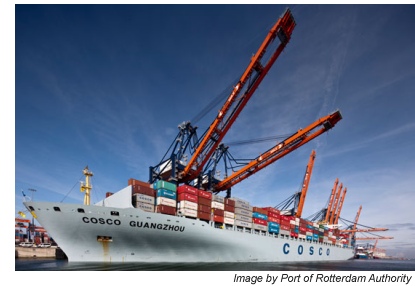 Hans Smits, CEO of the Port of Rotterdam Authority: ‘On the whole, throughput has maintained the high level of 2010. This also applies to investments from both the Port of Rotterdam Authority and companies. The growth in total throughput was hindered mainly by the loss in handling of oil products, which was very strong in the first quarter of 2010. Maintenance work to refineries was also relatively high. The 7 million tonnes decrease in the oil sector was almost entirely compensated by the more than double digit growth of containers. Just in the first half year, for the first time in decades, an entirely new cargo category was conveyed. LNG will not only contribute to transfers but especially to the structural strengthening of the industrial sector in the port and in the strategic energy position of the Netherlands and Western Europe. The Port of Rotterdam's positive development is connected strongly to world trade, especially that related to China and Germany. The significant unrest on the financial markets and its influence on the trust of consumers and producers can have a negative influence on world trade and thus on our throughput. There is a significant need for quicker and clearer political decision-making to sway negative sentiments. I expect that throughput in the third quarter will stay on target. July was a good month and the cargo for August and September is already in the pipeline. In spite of insecurity about the fourth quarter, I expect throughput for the entire year to show a light growth.’