|
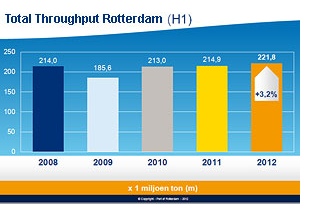
Dry bulk The total amount of dry bulk fell by 8.7% to 39.4 million tonnes. Agribulk (grains, seeds, animal feed ingredients) throughput was down by a tenth to 4.1 million tonnes. Due to increases in the price of products on the world market, customers utilised their stocks. Also, a few packages won from Amsterdam last year were lost again. 12.9 million tonnes of coal (+1.9%) were handled. Despite the declining flow of ores, imports of cokes coal were up, due to the closure of a coke mine in Germany. ThyssenKrupp also focused European coke imports on the EECV terminal. Weak imports of coal for energy in the spring will probably continue in the summer. As a result of the increasing availability of sustainable energy, coal is becoming more season-bound. Demand will probably increase again later in the year. Throughput of ores and scrap fell by 15.1% to 16.4 million tonnes. The production of raw steel is falling due to a decrease in demand as a result of the ailing economy. Utilisation of the blast furnaces in the hinterland is expected to decline this year to 85%. Two steel plants have already closed and Arcelor does not rule out more shutdowns. At ThyssenKrupp, a furnace is being overhauled. Exports of scrap rose in the first half of the year due to the persistently high demand from the Turkish steel industry. Throughput figures for other dry bulk (mainly minerals for the production of glass, paper, steel and chemicals) were 8.8% down at 5.9 million tonnes. Metal-related industry, cars and machinery, in Germany and the Netherlands, and the chemical industry continue to produce at a reasonable level. However, steel production is on the decline and the construction sector remains in a bad way for the time being. In combination with a number of incidental factors, this leads to less demand for minerals and special ores. Liquid bulk The total volume of liquid bulk rose by 10.6% to 107.5 million tonnes. Incoming trade in crude oil was 9.6% up to 50.6 million tonnes, which is at the top end of the historic range. In the past six months, there were no maintenance shutdowns, as compared to two major ones in 2011 . In addition to this, production capacity elsewhere in Europe fell due to the (temporary) closure of refineries. This caused a partial shift of demand for refining capacity to Rotterdam. There was a sharp increase in the handling of mineral oil products, by 13.8% to 39.9 million tonnes. Fuel oil throughput was stimulated by imports from Russia and exports to Singapore due to positive arbitration and the availability of VLCCs. The increase in throughput was facilitated by an increase in the tank capacity at ETT (third phase), STR (more than doubled) and BTT (completely new). Other liquid bulk (basic chemical products, vegetable oils and fats, fruit juices) was 5.6% up to 16.8 million tonnes. This is largely due to the rising throughput figures for palm oil, as a result of such factors as the opening of the plant of Neste Oil. There was also an increase in imports of MTBE and biodiesel, mainly from Asia. However, there was another fall in ethanol imports. General cargo The general cargo sector was treading water at close on 75 million tonnes. Incoming container cargo was down slightly by 0.9%, but there was marked growth of 5% in outgoing trade. Imports from Asia fell due to the stagnating European economy. Exports to Asia and the United States are doing well though, thanks to Chinese demand for quality products and the slight recovery in the American economy. These movements are supported by the lower euro compared to the dollar. Short sea transport increased by 3%, thanks to the Mediterranean region and Scandinavia/Baltic. The British/Irish market is declining. In number of containers, throughput fell by 1.6% to 5.9 million TEU (-92,000) due to the changing import/export ratio with Asia. The number of empty containers leaving the port fell by almost twenty per cent. Roll-on/roll-off transport rose by 0.5% to 8.8 million tonnes. This is not a bad achievement considering the economic shrinkage in England. Given the on-going pressure on prices, continuation of the rationalisation in the sector is likely. Other general cargo had to relinquish most of its gains of the past twelve months: down 24.9% to 3.1 million tonnes. The main cause is the 25% fall in European demand for steel products (sheets, rods, rolls). As a result, fewer ‘slabs’ (tablets of raw steel) were imported from Brazil. There is a lot of movement in non-ferrous metal. Up to now, that is reflected in more storage and inland shipping traffic, thus outside the throughput statistics on the sea side. There was a slight fall in the handling of paper, wood and cellulose. Virtually all fruit now enters Rotterdam in containers. Port of Rotterdam Authority press release |
 Growth in throughput for Port of Rotterdam