|
“While there is still plenty of integration planning to do before we launch the proposed joint venture, this is an important milestone in our effort to create one of the world’s most competitive sustainable biofuels companies,” said Rubens Ometto Silveira Mello, Cosan’s Chairman of the Board and non-executive Chairman-elect of the proposed joint venture. With annual production capacity of over 2 billion litres, the proposed joint venture will be one of the world’s largest ethanol producers. The inclusion of Shell’s equity interests in Iogen Energy and Codexis would enable the joint venture to deploy next generation biofuels technologies in the future. The company will also generate electricity from sugar cane bagasse in cogeneration plants at all mills. Ten cogeneration plants are already operational. With total annual sales of about 18 billion litres of fuels, the proposed joint venture will have a competitive position in the Brazilian fuels distribution market built upon a network of about 4,500 retail sites. Today’s agreement follows the signing in February of a non-binding memorandum of understanding. With the transaction terms agreed, Shell and Cosan, which remain as competitors, will now focus on securing regulatory approvals and starting integration planning before launching the new company. The proposed JV would enable Shell and Cosan to establish a scalable and profitable position in sustainable biofuels – one of the most realistic commercial solutions to take carbon out of the transport fuels sector over the next twenty years – by building a highly competitive position in the most efficient ethanol producing country in the world and by exploring opportunities to produce and sell ethanol and sugar globally. Cosan and Shell would contribute the following to the joint venture: 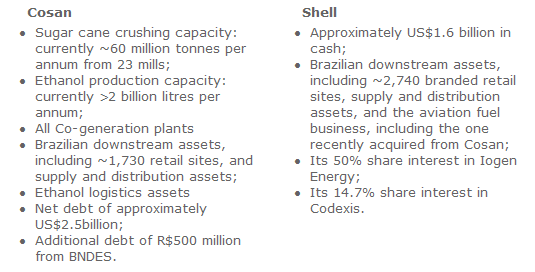
Neither Cosan nor Shell will contribute their Lubricants business to the proposed JV. Royal Dutch Shell plc is incorporated in England and Wales, has its headquarters in The Hague and is listed on the London, Amsterdam, and New York stock exchanges. Shell companies have operations in more than 100 countries with businesses including oil and gas exploration and production; production and marketing of Liquefied Natural Gas and Gas to Liquids; manufacturing, marketing and shipping of oil products and chemicals and renewable energy projects. For further information, visit www.shell.com. Brazil’s only totally integrated player in the renewable energy sector, Cosan has 23 sugarcane producing units, 21 of which are in São Paulo state, one in Jataí city (Goiás state) and one in Caarapó city (Mato Grosso do Sul state); four sugar refineries and two port terminals. The company is present in the retail sugar market, through the União and Da Barra brands, in the distribution fuels market, through the Esso brand, and in the production and distribution of lubricants for vehicles and industries through Mobil brand. Cosan is also one of the world major producers, traders and exporters of sugar and ethanol, and a major power producer from sugar cane bagasse. Iogen Energy is a technology development company dedicated to advancing cellulosic ethanol, jointly owned (50:50) by Iogen Corporation and Shell. The company has been producing cellulosic ethanol from wheat straw at its Ottawa demonstration plant since 2004. The demonstration plant produced more than 500,000 litres of cellulosic ethanol last year. Shell and Iogen Energy are working together on technical and commercial feasibility of a large-scale cellulosic ethanol plant. Codexis is a leading provider of optimized biocatalysts that make existing industrial processes faster, cleaner and more efficient than current methods and have the potential to make new industrial processes possible at commercial scale. Codexis has commercialized its biocatalysts in the pharmaceutical industry and is developing biocatalysts for use in producing advanced biofuels under a multi-year research and development collaboration. The company is also using its technology platform to pursue biocatalyst-enabled solutions in other bioindustrial markets, including carbon management, water treatment and chemicals. Shell |
 Shell and Cosan sign joint venture