|
Commenting on the 2009 First Half results Sergey Frank, Sovcomflot (SCF) Group President and CEO, said: “As anticipated the first half of this year proved to be a challenging time for the shipping industry. However the scale of the Group’s operations and our conservative chartering policy, combined with our industrial projects that provide considerable forward contract cover, allowed us to be much less impacted than many other players. SCF Group has maintained healthy profit margins and posted respectable bottom-line profits. More importantly, the Group continued to expand its fleet and made further progress in its diversification of services offered to Russian and international oil and gas majors and in providing integrated Seaborne Energy Solutions”. Financial results 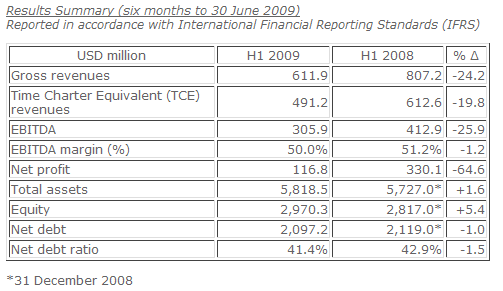
Gross revenue (freight and hire receivable) for the six months to 30 June 2009 was USD 611.9 million (H1 2008: USD 807.2 million). This 24.2 per cent decline over the first half of last year reflects a combination of lower demand and reduced spot freight rates. Time Charter Equivalent (TCE) revenues for the first half showed a moderate decline to USD 491.2 million, due to the conservative chartering policy pursued by the Group with a high percentage of term business (H1 2008: 612.6 million), while earnings before interest, tax, depreciation and amortisation (EBITDA) declined by 25.9 per cent to USD 305.9 million. Net profit for the period declined to USD 116.8 million (H1 2008: 330.1 million) affected on top of the decline in operational revenue by the absence in H1 2009 of certain non-operational items that contributed to the bottom line in H1 2008 and certain provisions for value impairment made as required under International Financial Reporting Standards (IFRS). Nikolai Kolesnikov, Executive Vice President & CFO said, “The Group performed creditably in the first six months of 2009, and maintains a comfortably low level of leverage and a strong current liquidity position, with a substantial amount of undrawn revolving credit facilities. The Group’s operational cash flows are sufficient to fully cover its committed capex needs. We also maintain a conservative approach to financing our business initiatives. As at 30 June 2009, there were 24 new vessels on order, at a total contracted cost of USD 1.37 billion, the Group’s existing shipbuilding programme is fully funded. The Group maintains a comfortable net debt ratio of 41.4 per cent and has an investment grade credit rating (from Moody’s, Baa2/stable).” Operations Evgeny Ambrosov, Senior Executive Vice President & SCF Group COO said, “During the first half of 2009, the Group continued to be well served by our conservative chartering policy, with almost two thirds of the fleet engaged on a time charter basis, and a growing portion of long-term industrial business which accounted for over 10 per cent of the Group’ revenues and vessel-days. The application of a business planning and consolidation system, based on the SAP platform, planned for the fourth quarter of 2009, will contribute to the improvement of the fleet operation control system and the optimisation of running and voyage expenses. During the first half we took delivery of a number of highly innovative vessels. The SCF Group fleet will top 10 million tonnes deadweight in the third quarter of 2009.” The Group took delivery of six new vessels in the first half of 2009. These included: three port tugs; two Aframax tankers (NS Arctic and NS Antarctic) and the 70,000 tonne Arctic shuttle tanker Timofey Guzhenko, With the introduction of Timofey Guzhenko, for example, this has enabled a further strengthening of our ice-class fleet. These advanced design vessels serve the Varandey project, a joint venture between Lukoil and ConocoPhillips, loading from a fixed offshore ice-resistant off-loading terminal (FOIROT) in the Barents Sea. The project passed its first anniversary of oil exports during the first half of 2009, following the first shipment of oil on 9 June 2008 by the Group’s tanker Vasily Dinkov. Since then, there have been 84 shipments carried and more than five million tonnes of oil shipped. This unique experience and technology puts Sovcomflot in a strong position for future projects in the Arctic region. Sergey Popravko, COO of tanker operations and MD of Unicom Management Services commented: “Providing a high quality of service to our customers and maintaining advanced standards of navigational safety is our primary task and the basis for the Group’s steady growth. The decline in the freight market is forcing many ship owners to reduce their operational expenses in order to control costs. In our Group this task is completed but not at the expense of the quality or safety of shipping service. Optimisation is first of all achieved by the improvement of logistics and the monitoring of costs. By optimising voyage planning only, in 2009, we’ll manage to reduce the consumption of bunker fuel by the Group’s ships by 10-12 per cent”. Sovcomflot (SCF) Group • Is one of Russia’s largest infrastructure enterprises. Its fleet comprises 143 vessels of 9.9 million tonnes (dwt) in total; • Its current shipbuilding portfolio includes 21 ships of an aggregate deadweight of 2.0 million tonnes (dwt); • The average age of vessels in the tanker fleet is six years (the world average age is 12 years); • SCF Group is a world leader in the product carrier segment; it is the second largest in the Aframax tanker segment and owns the largest ice-class fleet; • The Group’s services include not only transporting hydrocarbons for its customers, but also trans-shipping crude oil via FSO facilities, terminal management and developing effective logistics for transporting energy. OAO Sovcomflot Press Centre |
 Sovcomflot (SCF) Group: 2009 First Half Results