|
At the same time, we placed our corporate credit and senior unsecured debt ratings on OSG on CreditWatch with negative implications. Rationale The downgrade reflects our belief that OSG is facing a high probability of very near-term default, following the company's announcement today that it is evaluating strategic options including potentially filing Chapter 11. OSG also stated that its previously issued financial statements for the past three years ended Dec. 31, 2011, and associated interim periods for the quarters ended March 31 and June 30, 2012, should no longer be relied upon. Our downgrade of OSG also reflects Standard & Poor's criteria and definition for the 'CCC' rating category, including our definition of 'CCC-', which states that a default, distressed exchange, or redemption appears to be inevitable within six months, absent unanticipated significantly favorable changes in the issuer's circumstances. New York City-based OSG is one of the world's leading liquid bulk shipping companies. As of June 30, 2012, the company operated a fleet of 112 vessels (67 owned, 45 chartered-in), totaling about 10.7 million deadweight tons. The company will take delivery of two vessels in 2013, bringing its total fleet to 114 vessels. Operating both internationally and domestically in the competitive shipping industry, the company has high leverage and substantial revenue exposure to volatile spot markets. Positive credit factors include a well-established market position in the ocean transportation of crude oil and petroleum products and long-standing relationships with its customers, mostly major oil companies that have solid credit quality. We categorize OSG's business profile as "vulnerable," its financial risk profile as "highly leveraged," and its liquidity as "weak" under our criteria. Liquidity OSG has weak liquidity in our assessment. As of June 30, 2012, cash sources included existing unrestricted cash balances of $226.6 million. As of July 2012, the $1.5 billion revolving line of credit was fully drawn. Our liquidity assessment takes into account the lower revolver commitment of $900 million from the forward-start facility that will replace the existing revolver in February 2013. Our estimated sources of funds do not include potential asset sales because these are not assured. However, about 70% of the book value of OSG's fleet is unencumbered, providing an additional potential source of liquidity. We believe that OSG is in a liquidity crisis and the risk of default is imminent, absent unexpected new financing or relief from its lenders. OSG has a $1.5 billion revolver that will be replaced by a smaller $900 million forward-start facility in February next year. During July 2012, the company drew down an additional $343 million under the revolver, reducing availability to zero. Although we believe that a portion of that drawdown could be available as cash on the company's balance sheet, we expect that there will very likely be a liquidity shortfall even after taking into account cash on hand. As of June 30, 2012, cash sources included existing unrestricted cash balances of $226.6 million. Our estimated sources of funds do not include potential asset sales because these are not assured. However, about 70% of the book value of OSG's fleet is unencumbered, providing an additional potential source of liquidity. We expect OSG to use its liquidity sources primarily for debt service and for capital expenditures. Roughly $63.6 million is outstanding of OSG's $75 million 8.75% debentures that mature in December 2013. As of June 30, 2012, the company also had $46.5 million in remaining capital commitments for vessels scheduled for delivery in 2013. In accordance with Standard & Poor's liquidity methodology and assumptions, in our view, the relevant aspects of OSG's liquidity include: • A potential deficit of cash sources relative to uses over the next three quarters; • The likelihood that covenants will be breached unless there is a very credible plan to avert such a breach in a timely fashion or lenders appear likely to provide a covenant waiver or amendment; and • Indications of a poor standing in credit markets, as reflected in serious stock price decline (the current share price is down by roughly 90% from a year ago) and wide spreads on its bonds. However, the company retains core bank relationships. As of June 30, 2012, OSG was in compliance with and had moderate cushion on all its financial covenants. Financial covenants limit secured debt to 30% of assets (as of the credit agreement date) and investments in joint ventures (except liquefied natural gas joint ventures) to 30% of total assets. The credit agreement also requires maximum leverage (debt to total capitalization) of 0.6x, minimum net worth of no less than $1.2 billion, and minimum unencumbered tangible assets to unsecured debt of 1.5x. The company's liquidity problems are further compounded by the fact that its financial covenants tighten at the end of the fourth quarter. We believe that there is a high likelihood of a financial covenant breach when the new covenant levels become effective. The financial covenants use a different definition of debt than Standard & Poor's. We expect the company to continue to meet its covenant requirements. CreditWatch In resolving the CreditWatch listing, we will evaluate the steps OSG takes to address its liquidity crisis, including potentially filing for voluntary Chapter 11 protection. We will also assess the impact of any potential restatements of the company's financial statements on its operating prospects and financial viability. Related Criteria And Research • Criteria For Assigning 'CCC+', 'CCC', 'CCC-', And 'CC' Ratings, Oct. 1, 2012 • Methodology And Assumptions: Liquidity Descriptors For Global Corporate Issuers, Sept. 28, 2011 • Criteria Guidelines For Recovery Ratings On Global Industrials Issuers' Speculative-Grade Debt, 10/8/09 • Criteria Methodology: Business Risk/Financial Risk Matrix Expanded, May 27, 2009 • 2008 Corporate Criteria: Analytical Methodology, April 15, 2008 Ratings List Downgraded; Placed On CreditWatch To From Overseas Shipholding Group Inc. Corporate Credit Rating CCC-/Watch Neg/-- CCC+/Negative/-- Senior Unsecured CCC-/Watch Neg CCC+ Recovery Rating 3 3 Source: Standard & Poor's Financial Services LLC |
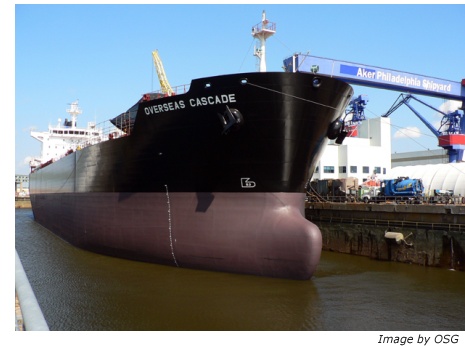 • U.S.-based global energy transporter Overseas Shipholding Group Inc.
filed an 8K today stating that it is evaluating strategic options, including a
potential filing for Chapter 11 bankruptcy protection.
• U.S.-based global energy transporter Overseas Shipholding Group Inc.
filed an 8K today stating that it is evaluating strategic options, including a
potential filing for Chapter 11 bankruptcy protection.