
Wärtsilä extends engine portfolio with 62- and 72-bore
electronically controlled low speed engines
Wärtsilä Corporation, Trade & Technical Press release, 19 May 2011
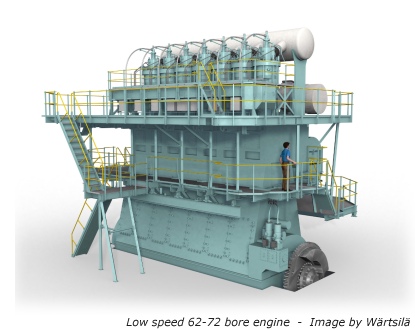 Wärtsilä, the marine industry’s leading ship power system integrator, strengthens its offering in the mid-size, low-speed engine sector by adding new 62- and 72-bore low-speed engines to its portfolio. These standardised engines offer high propulsion efficiency, reliability, and optimised total cost of ownership for customers in the bulker, tanker, and feeder container markets.
Both engines employ well-proven Wärtsilä low-speed technology, and incorporate electronically-controlled fuel supply and control. The 62-bore engine with a bore of 620 mm has four to eight cylinders, each with an output of 2660 kW at a speed of 97-103 rpm. The 72-bore engine has a bore of 720 mm and four to eight cylinders, each with an output of 3610 kW at a speed of 84-89 rpm.
Development work on the new engines is carried out at Wärtsilä’s Low-Speed Competence Centre in Winterthur, Switzerland following a feasibility study in 2010. Wärtsilä’s licensee partners in Asia are closely involved in the manufacturing process. The first 62-bore engine will be available for delivery in September 2013 and the first 72-bore engine will be available approximately one year later. All Wärtsilä licensees will have the right to build the new engines.
“At launch, the new engines are IMO Tier II compatible and available with IMO Tier III solutions. The design philosophy and main engine parameters have been selected to give high levels of reliability as the first priority. At the same time, the design enables the lowest possible manufacturing costs,” says Lars Anderson, Vice President, Merchant, Wärtsilä Ship Power.
Since the engine design parameters also allow for a compact engine room, shipyards can now use the same engine room module for various vessel types, from bulk carriers and tankers to container vessels. Furthermore, owners can rationalise their crew training and spares for the entire fleet.
Significant benefits for ship owners, operators, and shipyards
The new engines offer significant benefits to both shipowners and operators. The stroke/bore ratio offers good internal efficiency with a gain of 1-2 percent compared to current engines, and depending on the vessel type, the lower engine speeds make it possible to improve propulsion efficiency by 2-6 percent.
The layout fields of both engines are extended to maintain output, while allowing an increased shaft speed. The extended fields offer added flexibility to select the most efficient propeller speed for the lowest daily fuel consumption, and the most economic propulsion equipment, for a wide varity of vessel types. This concept was first applied successfully with the Wärtsilä RTA/RT-flex 82 bore engines.
The new engine designs also offer de-rating possibilities, which can further improve either the engine’s internal efficiency or its propulsion efficiency, or both. Overall efficiency gains of 5-8 percent at vessel level can therefore be expected. As this directly reduces the emission levels of carbon dioxide (CO2), sulphur oxides (SOx), and nitrogen oxides (NOx), it will be easier for shipyards to satisfy EEDI (Energy Efficiency Design Index) requirements.
Wärtsilä’s leading common-rail technology
Wärtsilä is the market leader in common-rail technology for electronically-controlled low-speed marine engines. These engines incorporate the latest electronically-controlled common-rail technology for fuel injection, valve actuation, engine starting, and cylinder lubrication with direct benefits to shipowners.
Wärtsilä’s common-rail technology provides a high degree of flexibility in engine settings to give lower fuel consumption, very low minimum running speeds, smokeless operation at all running speeds, and outstanding control of exhaust emissions. The integrated redundancy of the engines ensures high reliability. Furthermore, the excellent regulation of engine operation provided by the Wärtsilä electronically controlled engine system, allows for good manoeuvring capabilities and the lowest possible operating speed, for example, during canal passages and port entrance. Wärtsilä’s common-rail technology plays a key role in enabling shipowners to meet the challenges of higher fuel costs.
Wärtsilä in brief
Wärtsilä is a global leader in complete lifecycle power solutions for the marine and energy markets. By emphasising technological innovation and total efficiency, Wärtsilä maximises the environmental and economic performance of the vessels and power plants of its customers.
In 2010, Wärtsilä’s net sales totalled EUR 4.6 billion with more than 17,500 employees. The company has operations in 160 locations in 70 countries around the world. Wärtsilä is listed on the NASDAQ OMX Helsinki, Finland.
Wärtsilä Corporation, press release