|
Everllence B&W Mk10.7 engine family protects shipowner investments through modular design May 19, 2026
The Mk10.7 platform represents Everllence's latest generation of two-stroke engine design, developed around classic design principles and a modular architecture that supports conventional fuel operation (ME-C) as well as dual-fuel configurations, including methanol (ME-LGIM) and methane (ME-GI). This approach enables shipowners to make robust investment decisions today, while retaining the flexibility to adapt to evolving fuel supply-chains, regulatory frameworks and decarbonisation pathways over a vessel's lifetime. 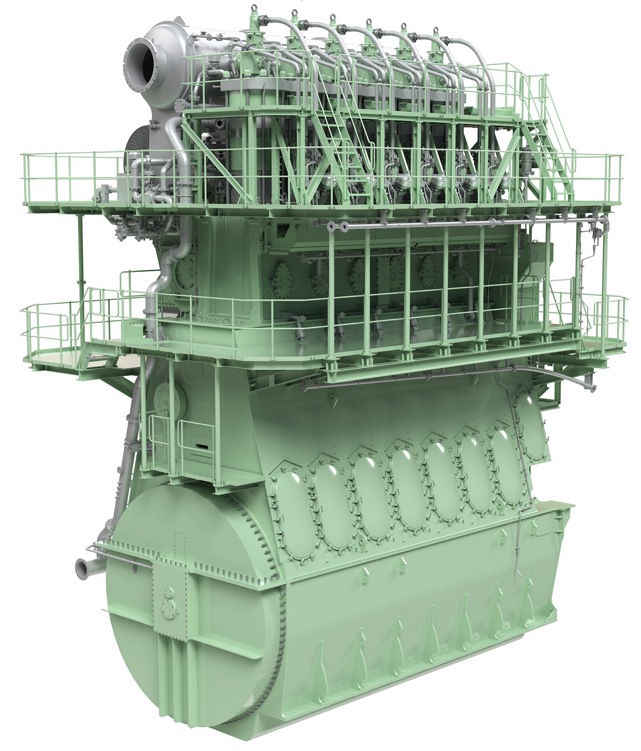
Graphical rendering of the Everllence B&W G70ME-C Mk10.7 engine. Image by Everllence.
Recent orders confirm the strong uptake of Mk10.7 single-fuel engines, alongside adoption of dual-fuel variants within the same engine architecture. As of April 2026, Everllence's orderbook comprises more than 160 x Mk10.7 engines, underscoring strong market confidence in the platform. Everllence views this momentum as clear validation of the Mk10.7 platform's role as a strategic foundation for modern newbuilding projects. Most recently, the Yantai CIMC Raffles shipyard in China ordered 8 x 6G70ME-C 10.7 LGIM (Liquid Gas Injection Methanol) engines in connection with the construction of eight containerships for Hapag-Lloyd. Hanwha Engine will build the engines in Korea; an option for six further engines exists. Christian Ludwig - Vice President, Head of Global Sales & Promotion, Two-Stroke Business, Everllence - said: "The Mk10.7 platform is designed precisely for this flexible market reality. By offering a common, robust engine architecture across conventional fuel and multiple dual-fuel options, we enable shipowners to balance efficiency, reliability and future optionality. This combination is increasingly becoming a cornerstone of energy security in newbuilding projects." Mk10.7 platform Designed with a modular architecture, the Mk10.7 platform delivers high efficiency based on well-proven design principles while providing well-defined pathways for conversion to alternative fuels, allowing shipowners to protect capital investments today and retain maximum flexibility for the fuel transition of tomorrow. This is across multiple vessel segments, including container vessels, pure car and truck carriers (PCTCs), tankers and bulk carriers supporting diverse operational profiles and trade patterns. 
Image by Everllence. Everllence - Press Release 
|
